
Quotation readiness case · clarification required
Why This Custom French Fry Cone Inquiry Needed a Die-Line and Food-Use Specification Before Quotation
The buyer supplied a useful folded-cone reference and clear branding direction, but missing structural dimensions, food-use conditions and production artwork prevented a comparable quotation.
The quotation decision: confirm the structure before calculating price
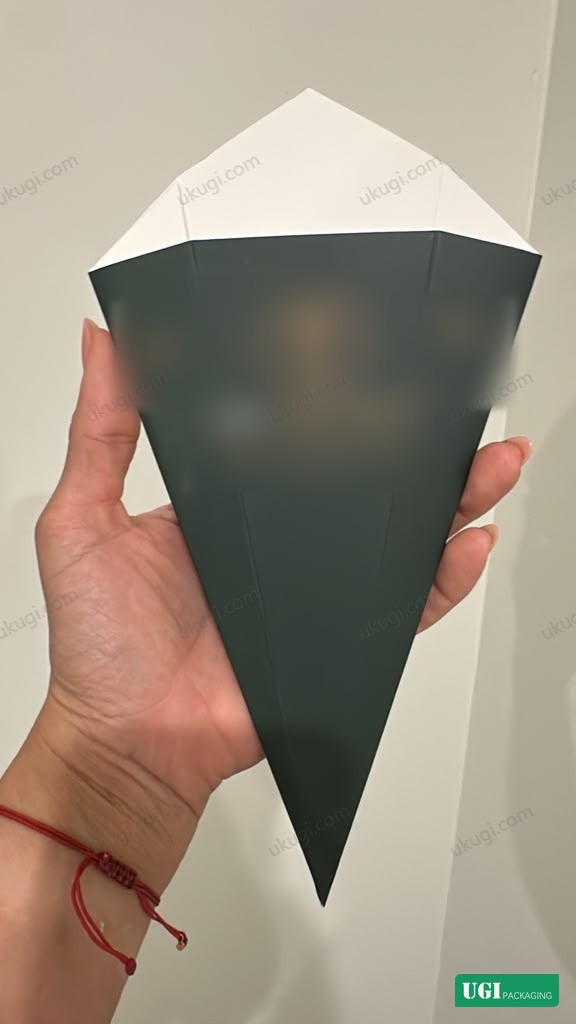
A US food-service buyer asked for a custom paper French fry cone rather than a stock cone with a sticker. The reference showed a folded triangular pocket-style structure with a white interior and a dark printed exterior. The buyer also described hot fries, grease resistance, dark green and gold branding, QR information and four quantity tiers.
The correct response was to pause final pricing. A supplier still needs the finished size, portion or load, flat structural drawing, paper and treatment choice, print references, usable artwork and delivery basis. Without those inputs, two quotations could describe different cones while appearing to answer the same request.
Case facts
Product concept
Custom folded triangular paper French fry cone
Application
Serving hot fries for a US food-service buyer
Requested quantities
1,000, 3,000, 5,000 and 10,000 pieces
Current status
Quotation readiness review; key inputs still pending
What the buyer supplied
The buyer requested a custom folded cone made from food-grade paper for hot French fries. The brief asked for grease or oil resistance, a dark green exterior, gold printing, front branding, side wording, a QR code and social-media information on the back, plus a professional printed finish.
The requested commercial comparison was also clear: prices for 1,000, 3,000, 5,000 and 10,000 pieces, a physical sample before mass production, sample cost, production time, MOQ and delivery to a US destination.
Why the photograph is not enough to make the dieline
The image helps identify the general construction: a folded triangular pocket rather than a simple rolled cone cup. It does not reveal every flat-panel dimension, fold allowance, sealing or gluing area, opening size, portion capacity, tolerance or printable boundary.
For a fully custom shape, the buyer should provide either a confirmed flat structural drawing or a physical sample that can be measured. If neither is available, the supplier may be able to develop a structure, but that becomes a separate structural-development task with its own assumptions, approval steps and possible charge. A photograph alone should not be treated as permission to invent the production dieline.
For the same reason, the image cannot establish the final paper grade, load capacity, food-contact documentation or grease-resistance performance.
Known information, missing inputs and quotation impact
| Known / still needed | Evidence or question | Why it changes the quotation |
|---|---|---|
| Known: folded triangular pocket style | The reference indicates a pointed folded structure with a white interior and printed exterior. | The flat pattern, fold lines, gluing or sealing points and cutting method determine material use and setup. |
| Still needed: finished dimensions | Confirm height, opening dimensions, portion capacity and whether measurements are finished internal or external dimensions. | Size changes the dieline, paper consumption, packed volume, freight and the amount of fries the cone can hold. |
| Still needed: loaded product and use conditions | Confirm hot-food temperature range, expected grease contact, holding time, serving method and maximum fries weight. | The paper, barrier treatment, structure and validation plan depend on the actual food and handling conditions. |
| Still needed: paper and grease-resistant treatment | Confirm the preferred paperboard range and whether a coated or water-based grease-resistant route is acceptable. | Paper weight alone does not establish food-use suitability, oil resistance, stiffness or end-of-life claims. |
| Known: dark green and gold branding | Confirm print sides, coverage, process and Pantone or other approved colour references. | Colour count is only one cost input; coverage, substrate, registration and print method also affect setup and price. |
| Still needed: production artwork | Supply editable logo and QR assets, exact wording, fonts and approved print positions on the confirmed dieline. | A reference image or screenshot cannot reliably provide vector artwork, colour definitions, bleed or prepress data. |
| Still needed: sample level | Specify structural blank, digital proof, printed mock-up or production-representative sample. | Each sample answers a different question and carries different setup, material and timing assumptions. |
| Still needed: delivery basis | Confirm destination postcode, door or port delivery, Incoterm, duty or tax requirement and target date. | A delivered price cannot be compared until packed volume and shipment terms are defined. |
For broader buyer checks, see the Custom Food Packaging RFQ FAQ and the Food Packaging FAQ.
Artwork, dieline and digital mock-up are different deliverables
This enquiry also shows why “please make the design” can mean several different services. They should be separated before any chargeable work begins.
What is a packaging dieline?
A dieline is the flat structural drawing that defines cut lines, fold lines, gluing or sealing areas, the cone opening, the pointed closure and the printable panels. It is based on the approved structure and dimensions; it is not the same as a logo file or a rendered product image.
What is packaging artwork?
Artwork is the visual content placed on the approved dieline: editable logo files, exact wording, QR code, colours, fonts, graphics, print positions and any required bleed or safety margins. A screenshot can show intent, but normally cannot provide production-ready vectors or colour specifications.
What is a digital mock-up or proof?
A digital mock-up shows how the proposed design may look on the cone. It supports approval of placement and appearance, but it does not replace the structural dieline, a printed proof or a production sample.
When is design work chargeable?
Placing usable customer assets on an approved factory dieline is different from reconstructing a logo, developing a complete visual system, creating new illustrations or writing packaging copy. The buyer and supplier should agree whether the task is dieline adaptation, artwork layout, file reconstruction or full creative design; the fee, revision allowance, proof format and ownership of final files should be stated separately. No chargeable design work should begin without approval.
A factory-ready sequence for this project
- Confirm the serving format. State the height, opening, portion weight and whether the cone is held by hand, placed in a tray or used with another food container.
- Confirm the structure. Provide the dieline or physical reference sample, including fold, seal, glue and opening details.
- Define the food-use conditions. Record heat, grease, moisture, holding duration and any direct or indirect food-contact requirements.
- Select the material route. Compare the paper grade and grease-resistant treatment against the actual use conditions and required declarations.
- Prepare production artwork. Supply editable logo and QR files, exact copy, colour references and approved print areas.
- Choose the sample level. Decide whether the first approval requires a structural blank, digital proof, printed mock-up or production-representative sample.
- Confirm quantities and delivery. Keep the 1,000 / 3,000 / 5,000 / 10,000 comparison tied to one confirmed specification and one delivery basis.
What this Case does and does not establish
This Case records an anonymized custom French fry cone enquiry and the information needed to move it toward a responsible quotation. It does not establish a final paper grade, food-contact approval, grease-resistance result, print method, sample price, MOQ, production time, freight cost or completed manufacturing result. The reference image is not evidence that the pictured cone was made, approved or tested by UGI.
The useful result at this stage is a clearer decision gate: confirm the structure, use conditions, artwork and delivery basis before comparing prices.
Copy-and-send custom French fry cone RFQ template
A buyer can replace the brackets below and send the completed brief with a physical reference or dieline, product-use details and editable artwork assets.
Related UGI resources
Need help turning a cone reference into a quote-ready brief?
Send the reference together with the confirmed dimensions, portion weight, food-use conditions, editable brand assets and delivery details. We will separate structure, artwork, sampling and production questions before a final quotation is issued.