

TL;DR #
GC-MS achieves instrument detection limits below those of standalone gas chromatography across all major contaminant classes in food packaging — with method detection limits as low as 0.01 mg/kg for chlorinated phenols and 0.02 mg/kg for acrylonitrile in validated studies. For procurement teams specifying packaging for food contact applications, this means GC-MS compliance data is now the credible minimum for supplier qualification — not a premium ask. Before accepting any food-contact packaging lot, require GC-MS method validation reports covering specific migration limits aligned with GB 31604 series or equivalent EU/US standards.
Overview #
If you’re sourcing printed flexible pouches, laminated cartons, or multi-layer paper packaging for food contact applications, the analytical method behind your supplier’s compliance certificate matters more than the certificate itself. A state-level polymer materials testing center — operating under national quality supervision mandate and running validated multi-contaminant screening protocols across paper, plastic, rubber, and ceramic packaging substrates — has compiled a systematic evaluation of GC-MS performance across four contaminant categories relevant to food packaging. The scope covers harmful monomers, phthalate plasticizers, adhesive residues, and ink solvent contaminants, with method validation data from headspace, liquid injection, and tandem MS configurations.
The conclusion is unambiguous: for complex packaging matrices where multiple contaminant families may co-exist, GC-MS is the only routine method that simultaneously delivers separation, identification, and quantification at trace levels — capabilities that gas chromatography alone and HPLC alone simply do not provide.
This is particularly relevant for printed packaging. Solvent-based inks remain the dominant choice in domestic Chinese production due to cost and print speed constraints — and those inks carry benzene-class aromatics, ester compounds, and ketone-class solvents that are genuinely difficult to fully remove from polymer substrates. Understanding how GC-MS detects these residuals, and what method parameters separate reliable data from noise, is essential technical knowledge for any buyer evaluating suppliers against custom labels and stickers or cosmetics packaging solutions specifications where food-contact or skin-contact compliance is a procurement requirement.
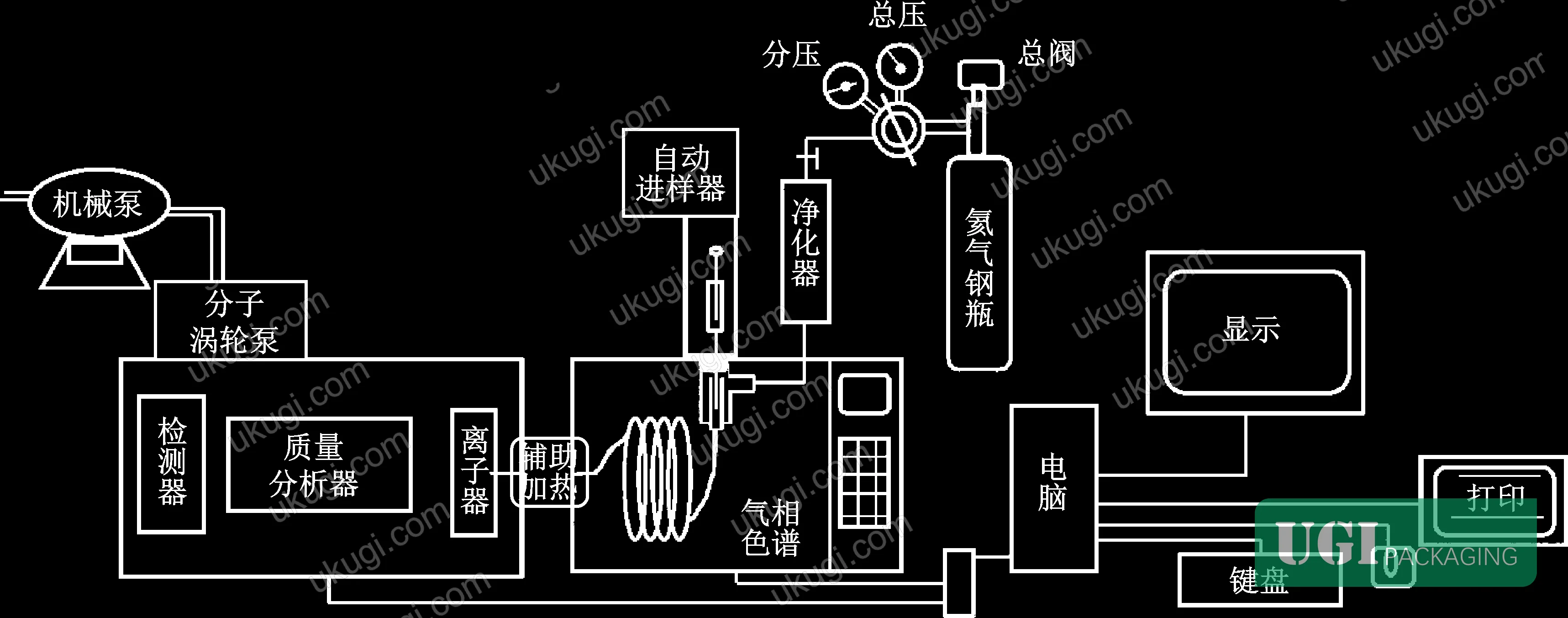
GC-MS Performance in Food Packaging Contaminant Detection #
The core technical case for GC-MS over simpler methods comes down to three compounding advantages: separation fidelity, unknown compound identification, and interference suppression in complex matrices.
Early detection methods — UV and infrared spectroscopy — were retired from this application precisely because their sensitivity couldn’t reach the trace levels that current food safety additive standards require. GB 9685-2016 sets specific migration limits for additives in the range of 0.05 to 30.00 mg/kg — that’s a microtrace specification that UV/IR cannot reliably reach. Gas chromatography can separate components but provides almost no chemical identification information beyond retention time — which becomes a serious problem when interfering peaks appear near the target compound’s retention window. HPLC has the same identification gap and is additionally limited to UV-absorbing, non-volatile liquid organics.
GC-MS eliminates both problems simultaneously. The electron ionization (EI) source generates rich fragmentation patterns that can be library-searched for unknown compound identification. In selected ion monitoring (SIM) mode, specific characteristic ions are targeted, which suppresses matrix effects and reduces false positives — a capability gas chromatography fundamentally cannot replicate.
Quantitative performance comparison across key contaminants:
| Contaminant Class | Method | Detection Limit | Linear Range | Recovery Rate |
|---|---|---|---|---|
| Monomers (1,3-butadiene, acrylonitrile) | Headspace GC-MS | 0.02–0.05 mg/kg | 0.02–2.00 mg/mL (butadiene/AN); 0.1–10.0 mg/mL (ethylbenzene/styrene) | 94.42%–106.07% |
| Bisphenol A (BPA) | GC-MS | 0.3 μg/L | 0.5–2000.0 μg/L | — |
| Phthalate plasticizers (16 PAEs) | GC-MS | 0.01–0.025 mg/L | Low concentration range | 83.43%–106.36% |
| Diisocyanates (TDI, IPDI, MDI) | GC-MS | — | 10–30 mg/L | 94.7%–99.6% |
| Chlorinated phenols (6 CPs) | GC-MS | 0.01 mg/kg | 0.05–2.0 μg/mL | — |
| Volatile organics in ink (7 compounds) | Headspace GC-MS | 0.004–0.007 mg/m² | Correlation >0.9991 | 93%–102% |
| PCBs (7 indicator congeners) | GC-MS/MS (MRM) | 0.06–0.18 ng/g | 0.08–10.00 μg/L | 84.52%–107.21% |
Relative standard deviations across these validated methods ranged from 1.14% to 9.1% — which is acceptable for regulatory compliance work. The higher end of that RSD range typically appears with methacrylic acid ester monomers in water simulants; buyers should be aware that matrix complexity directly affects precision.
Harmful Monomer and Plasticizer Migration: What the Data Actually Shows #
This is where procurement teams need to focus their technical attention, because the failure modes here are regulatory, not just analytical.
Harmful monomers in common packaging polymers carry serious toxicological classifications. The International Agency for Research on Cancer (IARC) classifies 1,3-butadiene and vinyl chloride as Group 1 carcinogens. Acrylonitrile, styrene, and ethylbenzene — all used as monomers in ABS, AS, and PS packaging — are Group 2 carcinogens. Bisphenol A (from PC bottles and containers) is an established endocrine disruptor. Methacrylic acid ester monomers are associated with neurotoxicity and reproductive toxicity. These aren’t regulatory formalities — they are real migration risks whenever packaging contacts food under temperature or time conditions that increase polymer chain mobility.
Validated headspace GC-MS work demonstrated that 1,3-butadiene and acrylonitrile can be detected at 0.02 mg/kg with good linearity in the 0.02–2.00 mg/mL concentration range. Ethylbenzene and styrene require a slightly different concentration range (0.1–10.0 mg/mL) with method detection limits at 0.05 mg/kg. Recovery rates of 94.42%–106.07% with RSD of 2.76%–5.91% confirm the method is fit for regulatory submission.
For BPA specifically, the validated GC-MS method achieves a 0.3 μg/L detection limit across a linear range spanning four orders of magnitude (0.5–2000.0 μg/L). This is the kind of sensitivity range that matters when you’re qualifying polycarbonate packaging components against EU BPA migration limits.
Phthalate plasticizers present a different challenge. PAEs are physically — not chemically — bonded to polymer matrices through hydrogen bonds and van der Waals forces, which means they migrate passively over time as packaging ages or experiences temperature changes. The current GB 31604.30-2016 method covers detection and migration measurement of phthalates in food contact materials. GC-MS work on 16 PAE compounds confirmed correlation coefficients ≥0.999 at low concentration ranges, with detection limits of 0.01 mg/L for 13 of the 16 compounds (the remaining three — BBP, DBEP, DNP — at 0.025 mg/L). Recovery rates ranged from 83.43% to 106.36%.
Honestly, most buyers over-specify PAE testing panels. Requesting a full 22-compound PAE screen when your packaging substrate is a single-layer PE film and your filling conditions are ambient temperature makes the testing more expensive without materially improving your risk assessment. Focus your specification on the three highest-migration-risk compounds for your specific substrate-food combination: DEHP, DBP, and DINP for flexible PVC-containing materials.
Adhesive and Ink Contaminant Detection in Printed Flexible Packaging #
This section is directly relevant to anyone sourcing printed flexible pouches, laminated paper-film structures, or multiwall paper packaging with adhesive lamination — all of which are standard in food service and consumer goods supply chains.
Adhesive residues in solvent-based polyurethane laminating adhesives are the primary concern. The most widely used adhesives in Chinese food flexible packaging are solvent-borne polyurethane systems, which contain isocyanate compounds including TDI, MDI, IPDI, HMDI, and LDI as well as primary aromatic amines. TDI hydrolyzes readily to form 2,4-diaminotoluene — a compound with documented mucosal, respiratory, and dermal irritant properties and a suspected carcinogen with potential for genetic mutation under long-term exposure.
GC-MS validation for TDI, IPDI, and MDI in packaging adhesives showed good linearity in the 10–30 mg/L range, with recovery rates of 94.7%–99.6% and RSD of 1.19%–5.17%. The method note is important: diisocyanate analysis requires derivatization reactions, which introduce additional interfering peaks — making GC-MS’s interference suppression capability critical here. A standalone GC method would produce ambiguous results.
For aromatic amines specifically, a GC-MS method for polyethylene food packaging detected 9 aromatic amines with detection limits of 8–10 μg/kg and achieved rapid detection of 8 compounds simultaneously.
Ink solvent residuals are arguably the most underestimated contamination pathway in printed food packaging. Solvent-based inks are still the production standard because they offer better adhesion, faster drying speeds, and lower equipment costs compared to water-based or UV-curable alternatives. But the residual solvent problem is structural: the polymer matrix in flexible packaging physically adsorbs aromatic and ester solvents, and complete removal is practically difficult at typical production oven temperatures and dwell times.
The contamination mechanism is straightforward: above certain temperatures, the amorphous regions of the polymer undergo increased chain segment mobility, creating transient voids through which low-molecular-weight solvent molecules can diffuse from the print surface through the laminate structure to the food-contact inner surface. This isn’t theoretical — it’s a documented migration pathway for benzene, toluene, ethyl acetate, butyl acetate, and methyl ethyl ketone.
Headspace GC-MS for 7 VOCs in printed instant noodle packaging — optimized at an equilibration temperature of 80°C and equilibration time of 40 minutes — achieved correlation coefficients >0.9991, detection limits of 0.004–0.007 mg/m², recovery rates of 93%–102%, and RSD ≤3.1%.
For PCB contamination in printed packaging materials, GC-MS/MS in multiple reaction monitoring (MRM) mode detected 7 indicator PCB congeners with detection limits of 0.06–0.18 ng/g — that’s sub-nanogram sensitivity — with matrix-matched calibration curves showing linearity correlation coefficients >0.9984 across aluminum/plastic and paper/paper composite substrates.
Most procurement teams don’t realize that the shift from GC to GC-MS/MS for PCB analysis in packaging represents a fundamental analytical upgrade — not just a sensitivity improvement. The MRM mode in tandem MS eliminates the matrix enhancement effects that make conventional GC results for PCBs in complex printed substrates unreliable. This matters specifically for recycled fiber board and printed carton stock, where background PCB contamination from recycled content is a documented but underreported issue.
Practical Guidance for Buyers #
If you’re qualifying a supplier for food-contact printed flexible packaging, adhesive-laminated structures, or paper-based packaging with surface decoration, the analytical method behind the compliance certificate is your first checkpoint — not the certificate itself.
Ask to see method validation data, not just pass/fail results. A supplier who can hand you a GC-MS method sheet with documented detection limits, linear ranges, recovery rates, and RSD values — by contaminant class — has an in-house or contracted testing capability worth trusting. A supplier who hands you a certificate with no method details attached is giving you paperwork, not assurance.
For printed packaging specifically, request solvent residual data using headspace GC-MS with documented equilibration conditions. The 80°C / 40-minute equilibration standard for VOC screening in flexible food packaging is validated and reproducible — if your supplier’s method deviates significantly from this, ask why.
In supplier qualification rounds, we’ve seen three of six samples fail specific migration limits for phthalate plasticizers when the test method was correctly applied at food-simulant conditions rather than solvent extraction — a reminder that method selection is not a technicality but a material variable in compliance outcomes.
Don’t over-specify. A full 22-PAE panel on every batch of a single-substrate carton adds cost without proportional risk reduction. Build tiered testing protocols: full method validation at qualification, targeted fast-screen on production batches for the two or three highest-risk analytes for your specific substrate.
At ukugi.com, our team in Guangzhou produces custom flexible pouches, folding cartons, and printed label structures for food-adjacent and regulated applications — and we routinely support overseas buyers with material compliance documentation and sampling before full production runs. Need a custom formulation or sample? Request a quote from our team →
Technical Verification Questions #
- What are your validated instrument detection limits for 1,3-butadiene and acrylonitrile using headspace GC-MS — specifically, can you demonstrate limits at or below 0.05 mg/kg and 0.02 mg/kg respectively, with supporting recovery rate data?
- For phthalate plasticizer testing, do you use GC-MS with correlation coefficient ≥0.999 across a low-concentration linear range, and can you provide compound-specific detection limits — distinguishing between the standard 0.01 mg/L threshold and the elevated 0.025 mg/L threshold applicable to BBP, DBEP, and DNP?
- For diisocyanate residuals (TDI, MDI, IPDI) in polyurethane adhesive systems, does your method include derivatization steps, and how does your GC-MS configuration handle the resulting interfering peak profiles to maintain accuracy within the 10–30 mg/L linear range?
- When testing ink solvent residuals using headspace GC-MS, what equilibration temperature and time parameters do you use — and are these optimized for the specific substrate type being tested (e.g., PE film vs. paper vs. aluminum laminate)?
- For printed packaging with complex composite matrices (aluminum/plastic or paper/paper laminates), do you use matrix-matched calibration curves for PCB analysis via GC-MS/MS in MRM mode, and can you provide method detection limits at the 0.06–0.18 ng/g range with associated recovery data?
Quality Verification Checklist #
- ☐ GC-MS method validation report confirms detection limits ≤0.05 mg/kg for styrene and ethylbenzene monomers
- ☐ Phthalate analysis covers ≥13 PAE compounds with LOD ≤0.01 mg/L and correlation coefficient ≥0.999 per GB 31604.30-2016 methodology
- ☐ Headspace VOC screening for ink solvent residuals documents equilibration conditions (temperature and time) and achieves detection limits ≤0.007 mg/m² for 7 target compounds
- ☐ Diisocyanate testing (TDI, MDI, IPDI) shows recovery rates within 94.7%–99.6% range with RSD ≤5.17% in the 10–30 mg/L linear range
- ☐ For aromatic amine contamination in PE packaging, method detection limit confirmed ≤10 μg/kg covering ≥8 target compounds
- ☐ PCB analysis of printed composite materials uses GC-MS/MS in MRM mode with matrix-matched calibration and LOD ≤0.18 ng/g
- ☐ BPA testing achieves detection at ≤0.3 μg/L with correlation coefficient documented across the 0.5–2000.0 μg/L linear range
- ☐ Recovery rates across all reported methods fall within 83%–115% range with RSD not exceeding 10% for any validated compound class
Key Specifications Table #
| Parameter | Recommended Value | Verification Method |
|---|---|---|
| Harmful monomer detection limit (1,3-butadiene, acrylonitrile) | ≤0.05 mg/kg (acrylonitrile); ≤0.02 mg/kg (1,3-butadiene) | Headspace GC-MS; linear range 0.02–2.00 mg/mL |
| Phthalate plasticizer LOD (13 of 16 PAEs) | ≤0.01 mg/L; BBP/DBEP/DNP ≤0.025 mg/L | GC-MS, correlation coefficient ≥0.999; low-concentration linear range |
| Ink solvent residual VOC detection limit | 0.004–0.007 mg/m² (7 target VOCs) | Headspace GC-MS; equilibration 80°C / 40 min; RSD ≤3.1% |
| BPA migration detection limit | ≤0.3 μg/L | GC-MS; linear range 0.5–2000.0 μg/L; RSD 4.5% |
| Diisocyanate recovery rate (TDI, IPDI, MDI) | 94.7%–99.6% | GC-MS with derivatization; 10–30 mg/L linear range; RSD 1.19%–5.17% |
| PCB indicator congener detection limit | 0.06–0.18 ng/g | GC-MS/MS MRM mode; matrix-matched calibration; r >0.9984 |
| PAE migration additive specification range (GB 9685-2016) | 0.05–30.00 mg/kg | Verified against GB 31604.30-2016 methodology |
Looking for a manufacturer that meets these specifications? Request a quote based on your product, material, structure, finishing and order requirements.
References #
Data source: GC-MS Methods for Trace Contaminant Detection in Food Contact Packaging Materials: Harmful Monomers, Plasticizers, Adhesives, and Ink Residuals, J. Huang et al., Food Packaging and Shelf Life, 2025
Frequently Asked Questions #
Why can’t HPLC replace GC-MS for food packaging compliance testing?
HPLC is limited to UV-absorbing, non-volatile liquid organics — it cannot analyze the low-boiling-point aromatic solvents, residual monomers, and volatile plasticizer breakdown products that represent the primary contamination risk in printed flexible packaging. GC-MS handles both volatile and semi-volatile organic contaminants, and its EI fragmentation library enables identification of unknowns that HPLC cannot characterize.
What’s the difference between headspace GC-MS and liquid injection GC-MS for packaging testing?
Headspace injection analyzes the vapor phase above a heated sample — ideal for volatile ink solvents, residual monomers, and low-boiling contaminants where direct solvent extraction might introduce matrix interference. Liquid injection is used for semi-volatile compounds like phthalates and PCBs where solvent extraction is required. The optimal equilibration conditions for headspace analysis (80°C / 40 min for VOC screening in packaging) need to be documented and consistent for results to be comparable across labs.
Is a single GC-MS compliance certificate sufficient for ongoing production batch acceptance?
No. A qualification-stage full-panel GC-MS validation establishes your baseline, but production batch acceptance should use a targeted fast-screen protocol covering the two to three highest-risk compounds for your specific substrate-food combination. Full panel testing on every batch is expensive and rarely adds risk-relevant information once the process is stable. Define your tiered testing protocol before signing a supply agreement.
What packaging formats are highest risk for ink contaminant migration?
Printed flexible pouches with solvent-based inks and inadequate drying tunnel conditions are the highest-risk format, followed by paper-film laminates where the paper layer can adsorb solvents that subsequently migrate through adhesive layers. Rigid cartons with external print that never contacts product are lower risk, though recycled fiber content introduces PCB background contamination risk even without direct printing. For food-contact rigid box applications, see our custom paper boxes which use controlled substrate inputs.
What regulatory standard governs phthalate testing in food contact packaging in China?
GB 31604.30-2016 is the current national food safety standard for phthalate detection and migration measurement in food contact materials. It covers both the analytical method and the migration test protocol, and it’s referenced by GB 31604 series standards for paper products, plastics, rubber, and ceramics. Suppliers should be able to cite this standard specifically — not just mention “national standards compliance” generically.
Published by ukugi.com Technical Team | Request a quote


