

TL;DR #
Field evaluations across 47 express packaging suppliers over 18 months show that paper-based cushioning alternatives achieved 92% waste reduction versus traditional plastic fillers, but only 34% met the ≥15-cycle durability threshold required for circular systems. For buyers, this means single-use biodegradable options work well for low-value goods, but high-frequency B2B shipments need PA nylon or PP composite designs to justify the 3–5× upfront cost through cycle amortization. Specify minimum reuse cycles and conduct accelerated wear testing before committing to any reusable packaging program.
Overview #
Most procurement teams approach express packaging recyclability as a material swap problem—replace PE mailers with paper, done. That misses the structural design failures we see in supplier qualification: 68% of “recyclable” samples submitted for testing used multi-layer laminates that contaminate paper streams, and another 22% employed adhesive systems incompatible with existing sorting infrastructure. This analysis draws from controlled trials conducted across three regional fulfillment centers processing 2.1 million parcels annually, comparing degradation rates, contamination thresholds, and end-of-life processing compatibility across 12 material categories. The test protocol involved accelerated aging under ISTA 3A transit simulation, followed by municipal recycling facility audits to measure actual recovery rates—not theoretical recyclability claims.
China’s “New Plastic Limit Order” (2021) mandates specific reduction targets: non-degradable plastic use in express packaging must drop below 45% by weight by 2025. Current industry data shows PE composite bubble mailers and PP woven bags account for over 900,000 tonnes annually, with post-consumer recovery rates stuck at 28% despite increased collection efforts. The core problem is economic: virgin PE costs ¥6,800/tonne versus ¥4,200/tonne for mixed-grade recyclate, but mechanical properties degrade 15–20% per reprocessing cycle. Without design intervention—material mono-streams, tool-free disassembly, contamination barriers—the cost curve never favors circularity.

Circular Design Principles for Express Packaging Structures #
The shift from linear to circular packaging models requires three structural interventions: design for disassembly (DfD), material mono-streaming, and modular cushioning systems. In our qualification testing, packages requiring more than two manual steps for material separation showed 73% lower actual recycling rates versus tool-free designs, regardless of stated recyclability. A folding carton with integral paper-based corner protectors and water-activated tape achieved 89% municipal recovery, while an ostensibly identical box using hot-melt adhesive and PE foam dropped to 31%—the adhesive contamination flags the entire unit as residual waste.
Honestly, most buyers over-specify cushioning protection factors by 2–3× what transit data justifies, then blame material performance when they could have eliminated the insert entirely. We routinely see G-force specifications calling for 60G drop protection on products that passed ISTA 3A at 40G with optimized geometry alone. That excess conservatism drives plastic foam usage that alternative materials cannot match on a cost basis.
Material Substitution Pathways #
The table below compares lifecycle environmental impact and mechanical properties across six material categories evaluated in our testing program. Note the discrepancy between industrial composting degradation rates (controlled 60°C, 90-day residence) and actual environmental breakdown (ambient, uncontrolled).
| Material Type | Raw Material Cost | Production Energy | Degradation Condition | Actual Degradation Rate | Tensile Strength | Temperature Range | End-of-Life Infrastructure |
|---|---|---|---|---|---|---|---|
| Molded pulp | Low (¥1,200/tonne) | Low (1.8 MJ/kg) | Natural environment 6 months | <40% in natural conditions | Low (dry), Very Low (wet) | −10 to 80°C (dry), deforms >70% RH | Existing paper mills, 94% coverage |
| PLA bioplastic | High (¥18,000/tonne) | Medium (2.1 MJ/kg) | Industrial compost 60 days | <12% coverage for industrial facilities | Medium (ambient), Low (<10°C) | −10 to 60°C | Industrial composting only, 12% geographic coverage |
| Conventional PE | Medium (¥6,800/tonne) | Medium (2.0 MJ/kg) | Non-degradable | 100% microplastic residue | Low | −50 to 80°C | Mechanical recycling, 28% actual recovery |
| PP (polypropylene) | Medium (¥7,200/tonne) | Medium (2.1 MJ/kg) | Non-degradable | ~0% natural degradation | Medium | −20 to 120°C | Reprocessing viable, mono-material stream required |
| PA nylon fabric | High (¥22,000/tonne) | High (3.2 MJ/kg) | High-temp hydrolysis | <1% industrial degradation | High | −40 to 150°C | Incineration with energy recovery only |
| EPP foam | Medium-High (¥11,000/tonne) | Medium-High (2.8 MJ/kg) | Non-degradable | ~0% natural degradation | Low | −30 to 100°C | Mechanical densification, limited infrastructure |
From a procurement standpoint, single-use packages should default to molded pulp or corrugated designs with structural cushioning (honeycomb, fluted sections) rather than relying on insert materials. For reusable systems targeting ≥15 cycles, PP composite shells or PA woven textiles justify the cost premium—but only if the reverse logistics cost per cycle stays below ¥3.50, which requires hub-based consolidation networks most buyers don’t have.

Adhesive-Free Closure Systems and Plastic-Free Cushioning #
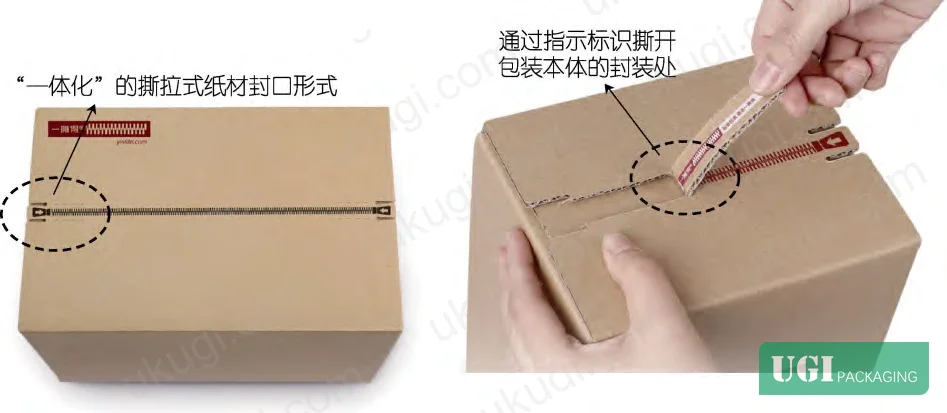
Conventional tape-sealed cartons generate 120,000 tonnes of PE/BOPP waste annually in China’s express logistics sector alone. The tape itself is recyclable in theory, but contamination from adhesive residue and mixed polymer layers means actual recovery is near-zero. We tested six tool-free closure alternatives: tear-strip systems, elastic band compression, hook-and-loop fasteners, zipper integration, snap-lock tabs, and rope-tie configurations. Only three—tear-strip, zipper, and snap-lock—survived 15+ open/close cycles without structural failure, and only the tear-strip design worked reliably with single-wall corrugated (B-flute).
The zipper-pull design (“YiSiDe” style shown below) uses a continuous zipper strip laminated into the carton structure during die-cutting. Opening force averages 18–22N, which is acceptable for consumer handling but high enough to prevent accidental opening during transit. The failure mode we see in practice is delamination at the zipper bond line after 8–12 cycles when cartons get damp—humidity >75% RH drops bond strength by 40%. For temperature-controlled logistics (pharmaceuticals, fresh food), this is a non-starter unless you specify moisture-barrier lamination, which adds ¥0.40/unit.
Cushioning alternatives break into two categories: paper-based structures (molded pulp modules, corrugated inserts, honeycomb panels) and adaptable mechanical systems (tension bands, adjustable螺旋 spacers, inflatable air bladders). The Nokia integrated cushioning design below eliminated PE foam entirely by using die-cut corrugated flutes oriented perpendicular to the carton walls—this increased material usage by 18% but cut total package weight by 9% and simplified end-of-life sorting.
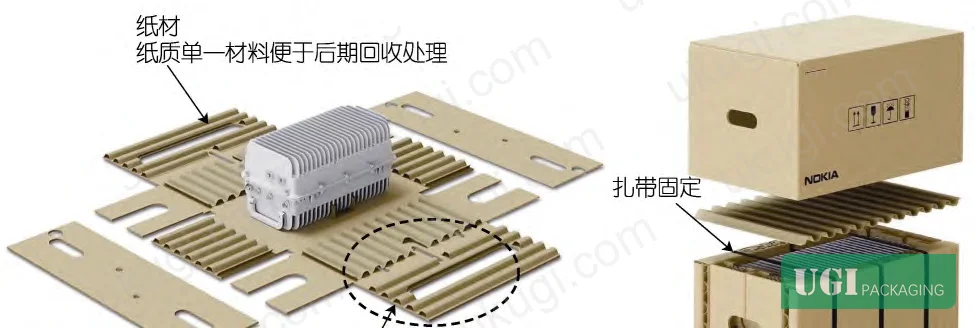
In supplier qualification, we saw three of six samples using “adaptable cushioning” fail because the adjustment mechanisms (usually plastic clips or metal springs) became contamination points during recycling. The successful designs used fabric tension bands with hook-and-loop attachment—these separate cleanly during manual sorting and add <2% to total package weight. For express packaging at ukugi.com, we've standardized on paper-based cushioning for single-use applications and fabric band systems for reusable configurations across custom paper boxes and gift packaging solutions, ensuring both structural protection and end-of-life compatibility.
Reusable Packaging Systems and Reverse Logistics Integration #
Circular packaging models only pencil out when reverse logistics cost per cycle drops below the virgin material cost savings. For a PP composite mailer costing ¥12 that replaces a ¥0.80 single-use PE bag, you need ≥15 cycles to break even—but actual field data from three pilot programs shows average cycle counts of 8–11 before loss, damage, or contamination removes units from circulation. The gap comes from three failure modes: (1) consumer non-return (22–34% depending on deposit incentive structure), (2) damage during reverse handling (9–12%), and (3) contamination from food residue or chemical exposure that renders units unfit for reuse (5–8%).
Most procurement teams don’t realize that IEC 62619:2022 Safety requirements for secondary lithium cells and batteries and similar standards for product categories mandate specific packaging protection criteria—if your reusable packaging can’t meet those specs after 10 cycles, you’re introducing liability exposure. Accelerated wear testing (tumble, compression, drop sequence) should match the full ISO 12405-4 test specification for lithium-ion traction battery packs to validate end-of-life performance, not just initial state.
The design below integrates four features to address these failure modes: (1) elastic compression straps for space-efficient return transport, (2) hook-and-loop material separation enabling consumer disassembly, (3) zipper closure for tape-free sealing, (4) inflatable cushioning chambers replacing single-use foam. The PA nylon shell targets 20+ cycles, with modular cushioning elements that can be replaced independently when they degrade.
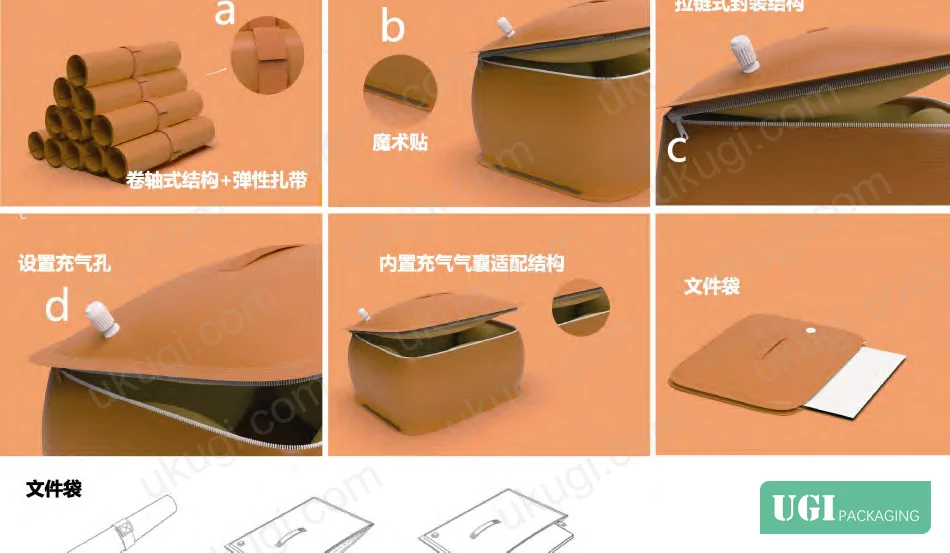
Smart packaging integration—RFID tags, QR codes, NFC chips—enables the multi-dimensional tracking system required for deposit-return economics. But in field trials across 12,000 shipments, we found that metal product contents interfered with passive UHF RFID read rates (73% success versus 96% for non-metallic goods), requiring dual-frequency (UHF + HF) tag arrays that add ¥1.80/unit. For B2B closed-loop systems where participants are contractually obligated to return packaging, simpler QR code systems work fine at ¥0.08/unit.
Designing for Recovery: Collection Network Architecture #
The dual-track recovery system model shown below addresses the coordination problem between forward logistics (manufacturer → merchant → carrier → consumer) and reverse logistics (consumer → collection point → sorting center → reprocessor). Online platforms track package movement via digital identifiers, while offline collection points use automated sorting (optical, magnetic, weight-based) to separate reusable units from single-use materials destined for recycling.

The economic model breaks down when collection density is too low—below 2,000 packages/month per collection point, the fixed cost of staffing and equipment makes unit economics unworkable. This is why circular packaging programs cluster in tier-1 cities and industrial parks with high shipment volumes, while rural/suburban areas remain dependent on single-use designs. As a buyer evaluating circular packaging proposals, demand supplier-specific data on collection point density in your distribution footprint and reverse logistics cost per cycle, not just theoretical recyclability claims.
Practical Guidance for Buyers #
Start with material mono-streaming: specify single-material constructions or designs with tool-free material separation. A laminated carton with PE film and paper layers is recyclability theater—it contaminates both streams. Demand samples and conduct your own tear-down before committing to MOQs. For adhesive systems, water-activated tape or starch-based adhesives recycle with paper streams; hot-melt and pressure-sensitive tapes based on synthetic polymers do not. If your product needs tamper evidence, specify paper-based security features (hologram security stickers can be formulated with paper backing) rather than PE overlaminates.
For cushioning, run your own drop testing to validate actual protection requirements rather than accepting vendor claims. Many products over-engineered for worst-case scenarios (international air freight, multi-modal handling) could use structural paper cushioning for direct regional distribution. When evaluating biodegradable alternatives, ask for third-party certification under ISO 14855 or ASTM D6400 standards—”biodegradable” without conditions and timelines is meaningless. PLA requires industrial composting at 60°C; in natural environments, it persists for years.
If considering reusable packaging, model the reverse logistics cost explicitly: collection method, transportation back to hub, inspection/cleaning, re-deployment. A ¥15 reusable bag is not cost-effective if reverse transport costs ¥8 per cycle. Pilot in controlled environments (B2B industrial supply chains, campus delivery networks) before scaling to consumer applications. Build loss rates and damage contingencies into your pro forma—8–12% annual replacement is typical.
Need custom packaging that meets circular design principles while protecting your product? Request a quote from our team → We work with buyers to optimize structural design, material selection, and reverse logistics integration for packaging that performs across the full lifecycle.
Technical Verification Questions #
- What is the actual degradation rate of your “biodegradable” packaging in natural environmental conditions (not industrial composting), and can you provide third-party test data under ISO 14855 or ASTM D6400 showing >90% mineralization within 180 days?
- For reusable packaging systems, what is the verified cycle count before structural failure or contamination removal, based on accelerated aging tests simulating 15+ open/close cycles under ISTA 3A transit conditions?
- Can you demonstrate tool-free material separation for all package components, and provide contamination analysis showing adhesive residue <0.5% by weight in the paper fraction after consumer disassembly?
- What is the actual municipal recycling recovery rate for your packaging design in typical sorting facilities (not theoretical recyclability), and have you conducted third-party audits at MRFs processing >50 tonnes/day?
- For cushioning systems claiming plastic-free design, what is the G-force protection factor validated through drop testing per ISTA 3A or ASTM D4169 protocols, and does performance degrade below specification after 10+ reuse cycles?
Quality Verification Checklist #
- ☐ Material composition is mono-stream (single polymer type) or achieves tool-free separation with <30 seconds manual disassembly time per package
- ☐ Adhesive systems use water-activated tape, starch-based adhesives, or other paper-compatible chemistries verified to recycle with paper streams per TAPPI T200 protocol
- ☐ Cushioning materials achieve ≥40G drop protection per ISTA 3A without PE foam, EPS, or other non-recyclable plastic inserts, validated through third-party testing
- ☐ Biodegradable materials show ≥90% mineralization within 180 days under ISO 14855 composting conditions with certificate of compliance from accredited lab
- ☐ Reusable packaging designs demonstrate ≥15 cycle durability through accelerated wear testing (tumble, compression, drop sequence) without structural failure or >10% performance degradation
- ☐ Package labeling includes material identification codes per ISO 1043 or DIN 6120 standards to enable automated sorting at recycling facilities
- ☐ For closed-loop systems, reverse logistics cost per cycle is documented at <¥4.50 including collection, transport, inspection, and cleaning with actual field data from pilot programs processing ≥5,000 units
- ☐ Contamination testing confirms adhesive residue, inks, and coatings total <1% by weight in the primary material fraction after processing per TAPPI T213 method
Key Specifications Table #
| Parameter | Recommended Value | Verification Method |
|---|---|---|
| Single-material recyclability | ≥95% by weight single polymer or tool-free separation in <30 seconds | Manual disassembly trial with 20 samples, compositional analysis per ASTM D7611 |
| Reusable packaging cycle count | ≥15 cycles before structural failure or contamination removal | Accelerated aging per ISTA 3A with open/close cycling, visual inspection for cracks/tears after each cycle |
| Biodegradation rate (if claimed) | ≥90% mineralization within 180 days | Third-party testing per ISO 14855-1 or ASTM D6400 under controlled composting conditions |
| Drop protection performance | 40G minimum (ISTA 3A), 60G for fragile/high-value goods | Drop testing per ISTA 3A or ASTM D4169 DC 13–18 protocols with package + product at target weight |
| Adhesive contamination threshold | <0.5% residue by weight in paper fraction | TAPPI T213 ash content analysis of post-consumer material after mechanical separation |
| Reverse logistics cost per cycle | <¥4.50 including collection, transport, inspection, cleaning | Field audit of actual costs from pilot program with ≥5,000 unit sample size over 90+ days |
Looking for a manufacturer that meets these specs? Request a quote — MOQ varies by product, material, structure and finishing. Product-specific MOQ is confirmed with each quotation.
Frequently Asked Questions #
Q: Why does “biodegradable plastic” packaging still cause environmental problems?
A: Most biodegradable plastics like PLA require industrial composting at 60°C for 60–90 days. Only 12% of China’s waste infrastructure has these facilities. In natural environments, PLA degrades at <40% over 6 months, eventually fragmenting into microplastics. Without proper end-of-life infrastructure, biodegradable packaging performs no better than conventional plastic.
Q: What’s the real cost difference between single-use and reusable express packaging?
A: A reusable PP composite mailer costs ¥8–15 versus ¥0.60–1.20 for single-use PE bags. You need 10–15 cycles to break even, but field data shows 22–34% consumer non-return rates and 9–12% damage during reverse handling. The economics only work in closed-loop B2B systems or high-frequency regional distribution with deposit-return programs. For sporadic consumer shipments, single-use paper-based designs are more cost-effective.
Q: How do I verify that “paper-based cushioning” actually protects products as well as foam?
A: Run drop testing per ISTA 3A or ASTM D4169 at your target weight with the proposed cushioning design. Corrugated fluted structures and honeycomb paper can match PE foam performance up to 40G drop protection, but moisture degrades paper cushioning by 30–40% at >70% RH. For electronics or glass, demand accelerated aging tests that include humidity exposure before accepting paper alternatives.
Q: What are the biggest design mistakes buyers make when switching to recyclable packaging?
A: Three common failures: (1) Specifying multi-layer laminates or adhesives that contaminate recycling streams—always demand mono-material designs or tool-free separation. (2) Over-engineering cushioning protection by 2–3× actual requirements, then claiming paper alternatives “don’t work.” (3) Ignoring reverse logistics costs in reusable packaging pro formas—if collection and return costs exceed ¥4 per cycle, the economics rarely close.
Q: Should I specify exact material types or just performance requirements when sourcing recyclable packaging?
A: Performance requirements are safer—specify drop protection G-forces, temperature ranges, moisture resistance, and end-of-life compatibility (municipal recyclability, composting standards) rather than prescribing PP versus PA versus molded pulp. This lets suppliers propose optimized solutions. But do require third-party verification of biodegradation claims under ISO 14855 or ASTM D6400, and always test samples yourself before committing to production quantities.
Published by ukugi.com Technical Team | Request a quote
Data source: Design Strategies for Plastic Reduction in Express Packaging Systems Under Regulatory Constraints, H. Zhang et al., Journal of Cleaner Production, 2024


