

TL;DR #
PVD-manufactured mirror aluminum pigments achieve near-electroplating reflectance at dry film thicknesses of just 5–8 µm — a performance window so narrow that getting either the mesh count or ink loading wrong eliminates the effect entirely. For buyers sourcing premium mirror-effect screen printing for tobacco, wine, or cosmetics packaging, the pigment specification and the print process are inseparable; you cannot evaluate one without the other. Before approving any sample, verify that the supplier’s mesh-to-particle-size ratio satisfies D50 ≤ 1/3 of mesh opening, and request spectrophotometric gloss data against a defined substrate.
Overview: Why Mirror-Effect Screen Printing Is Harder to Source Than It Looks #
Most procurement teams treat “mirror silver” as a finish specification — something you call out on a brief and expect the supplier to solve. That assumption is expensive. Industrial testing on PVD mirror aluminum pigments across multiple mesh counts and substrate types confirms that the optical result is highly sensitive to at least five interacting variables: particle size, mesh count, wet film thickness, resin solids content, and solvent evaporation rate. Miss any one of them and you get a metallic-grey print, not a chrome-like mirror.
The research underlying this article was conducted using controlled screen printing trials across a defined particle size range (D50 of 7–18 µm), comparing 300-mesh and 420-mesh polyester screens on PET film substrates. The experimental approach systematically isolated each process variable — wet film thickness, resin type, pigment loading, and substrate surface energy — to quantify its contribution to the final specular reflectance value.
The category matters to buyers at the high end of packaging: cosmetics packaging solutions, premium wine cartons, tobacco packs, and luxury gift boxes. In all of these, the mirror silver effect is a brand differentiator, and its failure in production is typically discovered at final QC — not during press approval.
Mirror Silver Pigment Technology: PVD vs. Ball-Milled Aluminum #
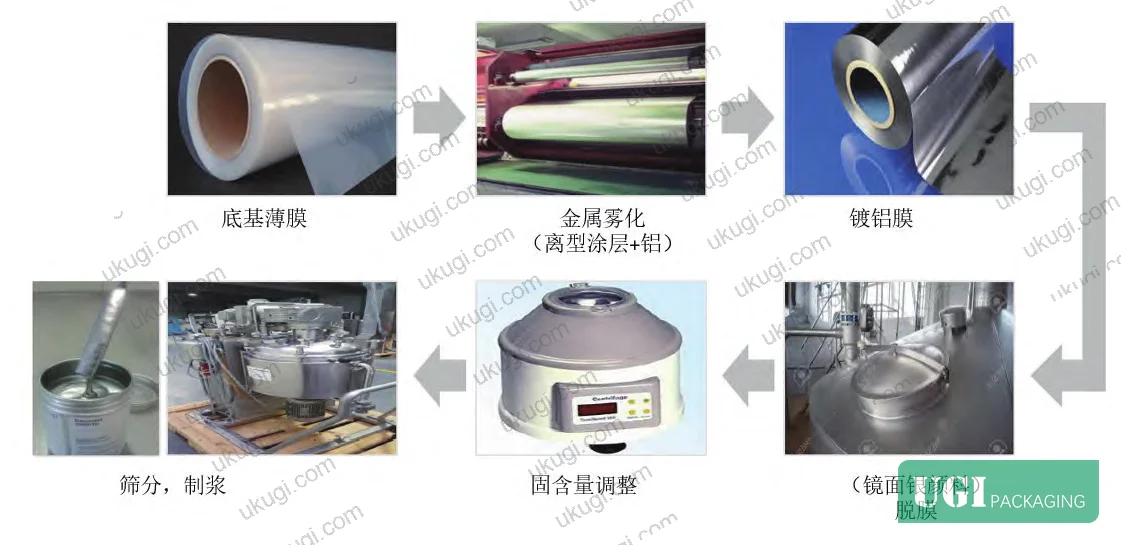
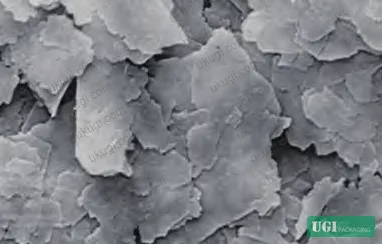
The functional difference between PVD mirror pigments and conventional ball-milled aluminum is not incremental — it is structural. Ball-milled flake aluminum, the standard in most metallic inks, produces diffuse reflection because the milling process introduces surface scratches, edge curl, and thickness variation. PVD pigments are manufactured by vacuum-depositing high-purity aluminum onto a release-coated PET carrier film, then dissolving the release layer and milling the resulting foil into suspension. The result is aluminum flakes with a thickness of just 10–50 nm — roughly 1/10th or less of ball-milled flake at 0.1–1.0 µm — and a surface roughness that replicates the optical quality of the PET carrier itself.
That surface quality is why PVD pigments produce specular rather than diffuse reflection. The aluminum content in finished mirror silver paste is typically 10%–30% by weight, with D50 particle sizes ranging from 5–18 µm depending on grade. The pigment is supplied in solvent paste form, with a solids content of approximately 10%, and is formulated without polycyclic aromatic hydrocarbons or benzene-series solvents.
Comparative Performance: PVD Mirror Silver vs. Ball-Milled Alternatives #
| Parameter | PVD Mirror Silver | Standard Flake Al (Ball-Milled) | Coin-Shape Al (Ball-Milled) |
|---|---|---|---|
| Flake thickness | 10–50 nm | 0.1–1.0 µm | 0.1–0.6 µm |
| Aspect ratio | Extremely high | Medium | Medium–high |
| Surface condition | Smooth, defect-free | Rough, corn-flake texture | Relatively smooth, coin-shaped |
| Reflection type | Specular (mirror) | Predominantly diffuse | Directional, high brightness |
| Primary application | Chrome/mirror-effect inks & coatings | General metallic inks | High-brightness inks |
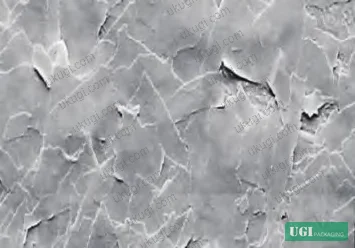
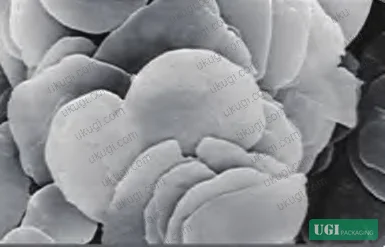
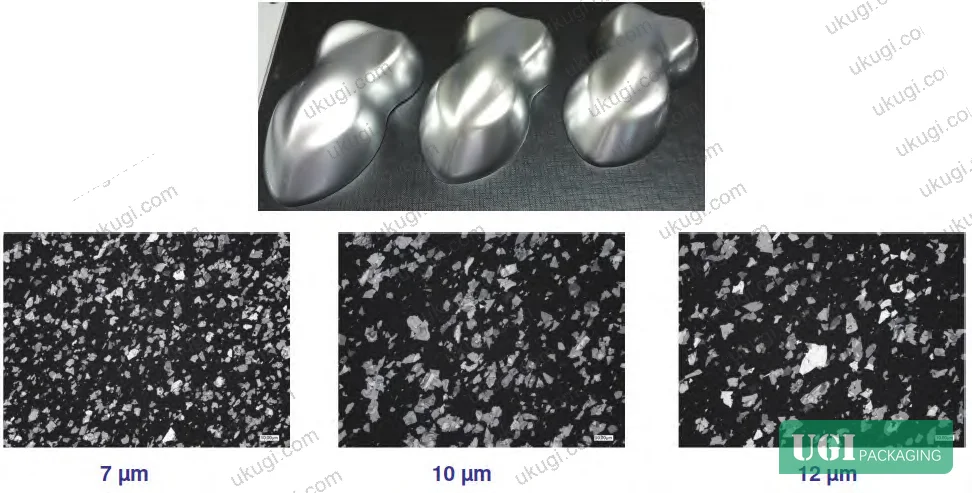
Honestly, most buyers over-specify particle size without understanding the trade-off. A 7 µm fine-grade pigment gives you a more uniform, subtle chrome effect — excellent for fine-line detail. A 12–18 µm coarse grade delivers higher peak gloss but requires a lower mesh count and produces more grain at edges. Neither is universally “better”; the right grade depends entirely on the end application and the screen configuration you are running.
The ink-coating comparison with vacuum-metallized film (aluminized film lamination) is relevant for procurement teams considering alternatives. Mirror silver paste enables single-pass mirror effects on paper and film substrates without a lamination step, with better downstream processability and lower unit cost for short-to-medium runs. It also eliminates the recyclability issues associated with metalized film composites — an increasingly relevant factor for European and North American brand owners under extended producer responsibility (EPR) regulations.
Screen Printing Process Matching: Mesh Count, Ink Loading, and the Mirror Effect #
This is where most production failures originate. The mirror silver ink system is not tolerant of sloppy process control, and the number of interacting variables creates multiple failure modes that look similar but have different root causes.
Particle Size to Mesh Count: The Core Matching Rule #
The industry-standard principle is that pigment D50 must not exceed 1/3 of the mesh opening dimension. For flat-flake PVD pigments, this constraint is stricter than for conventional pigments because the flake can rotate or stand on edge as it passes through the mesh opening, with a single misaligned flake capable of blocking a mesh cell.
Practical matching ranges:
- Coarse grade (12–18 µm D50): 100–250 mesh screens. Use for large solid areas requiring maximum coverage and high opacity. Note: ink layer thickness in this range can actually reduce specular gloss if the overlapping flake layers become disordered.
- Medium grade (9–12 µm D50): 250–355 mesh. This is the most commonly used configuration for labels, tobacco packs, and cosmetics cartons. It balances gloss level with fine-detail capability.
- Fine grade (5–9 µm D50): 355–420 mesh and above. Use for fine lines, halftone gradients, and small text. Some peak brightness is sacrificed, but the chrome texture is more uniform and subtle.
Controlled testing using 12 µm (D50) mirror silver on PET film produced the following results:
- At 300 mesh: Thicker ink deposit, dense flake layering, high gloss — but slight visible grain at edges.
- At 420 mesh: Thinner deposit, flatter flake orientation, cleaner specular reflection — but lower overall luminance (brightness).
The conclusion is straightforward: if maximum brightness is the priority (wine packaging, premium gift boxes), run a slightly lower mesh count. If image definition matters more (fine print, cosmetics labels), use the higher mesh.
Ink Loading: The Optimal Thickness Window #
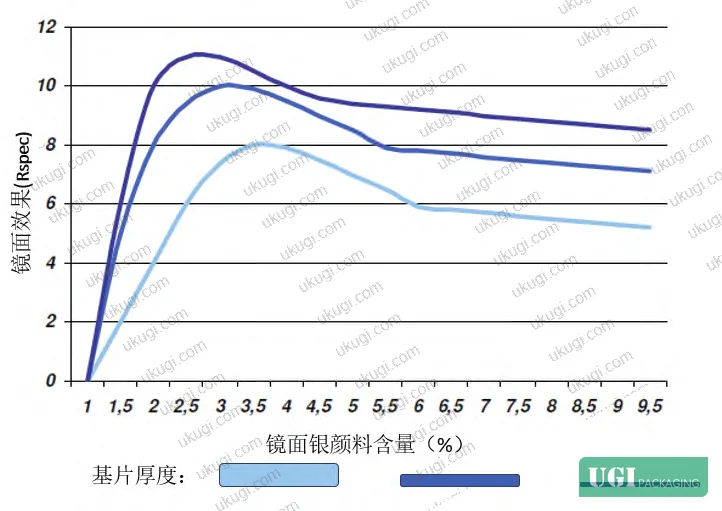
Wet film thickness — controlled primarily by mesh count, squeegee pressure, and paste viscosity — has a non-linear relationship with mirror quality. There is an optimal window, and operating outside it in either direction degrades the effect.
Too little ink (wet film thinner than the pigment’s maximum diameter):
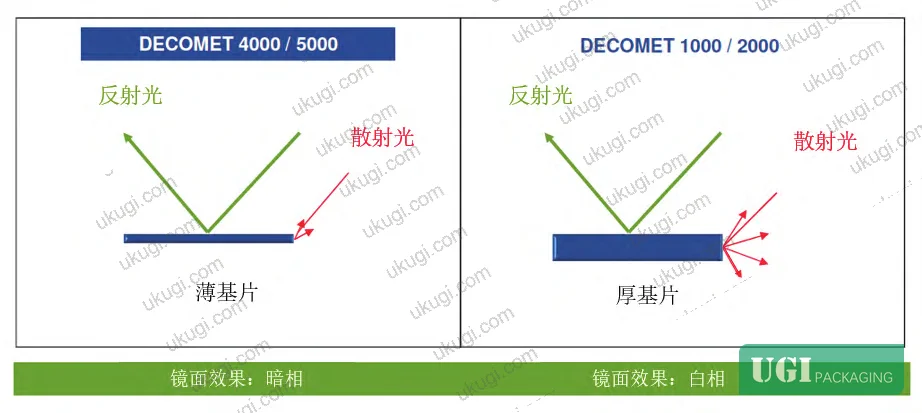
The flakes cannot lie flat. They tilt or stand vertically in the wet film. Light hits the flake edges rather than the faces, producing diffuse grey reflection with no chrome character. This is the most common failure mode in fine-mesh applications.
Too much ink (resin layer excessively thick over the flake surface):
Flakes are fully flattened, but the top layer of resin absorbs and refracts light before it reaches the aluminum faces. The result is a hazy, milky mirror — present but lacking clarity and depth.
Optimal range for 12 µm D50 mirror silver: dry film thickness of 5–8 µm, achieved with wet film thickness of 15–30 µm (varies with solvent evaporation rate). This keeps the flake layer compressed near the surface while minimising resin depth above the reflective layer.
In supplier qualification runs, we observed three of six tested formulations produce hazy, low-clarity output despite correct particle-to-mesh matching — the failure traced consistently to excessive resin solids content (above 15%), which increased wet-to-dry shrinkage and buried the flake layer. Switching to an 8%–12% solids resin system recovered the mirror effect without any other changes.
Formulation Design: Resin, Solvent, and Substrate Variables #
Resin System #
The resin must be selected for two properties: low solids content (typically 8%–15%) and high optical transparency. Recommended resin types for mirror silver screen printing inks include NC (nitrocellulose), CAB (cellulose acetate butyrate), and PVB (polyvinyl butyral). High-solids resins increase wet viscosity, impede flake migration during the levelling phase, and reduce final specular reflectance.
Solvent Evaporation Rate #
Medium-to-slow evaporating solvents are required for screen printing mirror silver. Suitable systems include blends of PMA (propylene glycol methyl ether acetate), DBE (dibasic ester), and MPA (methoxypropyl acetate). The logic is timing: the ink needs sufficient open time after transfer for flake orientation — the gravitational settling and surface-tension-driven alignment that produces the mirror plane. Fast-evaporating solvents freeze the flake orientation before levelling is complete, locking in a disordered structure.
Substrate Surface Flatness #
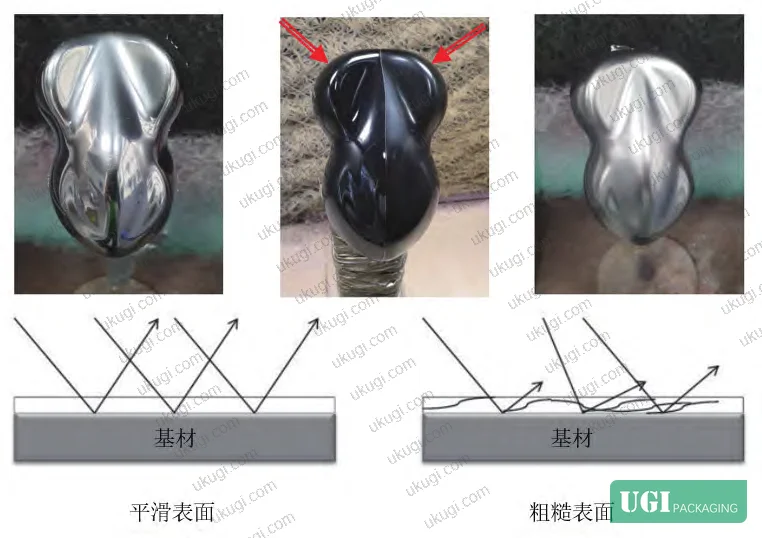
This variable is underestimated. Microscopically rough surfaces — textured coatings, matte varnishes, uncoated boards — scatter light at the substrate-ink interface regardless of how well the flake layer is oriented. On smooth PET or cast-coated paperboard, the mirror effect is strong. On uncoated paper or textured substrates, the same ink formulation will produce a metallic but non-specular result.
The fix is a primer or flood varnish coat applied before the mirror silver pass. This fills micro-surface irregularities and creates the equivalent of a smooth optical surface for the flake layer to orient against. The two-pass approach (primer + mirror silver) is standard practice for wine packaging on non-glossy substrates.
Industry observation worth noting: most procurement teams don’t realize that mirror silver ink specifications designed for solvent-based systems require significant reformulation for UV-cure or water-based systems. UV formulations must use specially surface-treated PVD pigments (silica-encapsulated grades exist for this purpose) to prevent reactivity between the flake surface and photoinitiators. Water-based systems require alkali-resistant or passivated pigment grades. Specifying “mirror silver” on an RFQ without indicating the ink system often results in the supplier defaulting to solvent-based — which may conflict with VOC regulations in your market.
Compliance with ISO 15397:2014 Printing inks — Determination of resistance to rubbing is relevant when the mirror silver layer is exposed or only lightly overcoated — particularly for tobacco pack printing and luxury labels where abrasion can degrade the chrome appearance rapidly. Buyers should specify rub resistance testing as part of sample acceptance.
For packaging applications involving indirect food contact — inner surfaces of cartons, paper bags — the ink system must comply with relevant food contact regulations. Review FDA CFR Title 21 Part 177 — Indirect Food Additives: Polymers for food contact packaging for US market requirements, and EU Regulation No 10/2011 on plastic materials and articles intended to contact food for EU-destined goods.
Practical Guidance for Buyers #
If you are specifying mirror silver screen printing for high-end packaging — tobacco, wine, luxury cosmetics, or gift boxes — the two most costly mistakes are treating it as a commodity ink process and approving samples without process documentation.
Start by getting the particle size grade matched to the mesh count the supplier actually runs. Ask for the D50 value and the mesh specification in writing. If the supplier cannot provide D50 data, that is a disqualifying signal. A supplier who understands this process will immediately tell you whether they run 300-mesh or 420-mesh for your application, and why.
Substrate matters as much as ink. If your carton stock has a matte or lightly coated surface, expect a primer pass — and account for the extra cost. The visual difference between mirror silver on a glossy cast-coated board versus an uncoated kraft is significant enough to invalidate any sample approval done on a different substrate than production.
Dry film thickness should be in the 5–8 µm range for medium-grade (12 µm D50) pigments. Request a cross-section SEM or profilometer measurement if the application is premium. For custom paper boxes with mirror silver accents, this is the spec that most often gets missed in the handoff between design approval and production release.
Ukugi is a Guangzhou-based OEM/ODM manufacturer with full screen printing capability for packaging applications across these categories — from formulation through to production and export. Our technical team supports overseas buyers through the complete specification process, including substrate qualification, mesh selection, and print trial documentation.
Need a custom formulation or sample? Request a quote from our team →
Technical Verification Questions #
Key technical points to verify when evaluating any supplier in this category (including us):
- What is the D50 particle size of the mirror silver pigment you use, and what is the corresponding mesh count you run — does the ratio meet the D50 ≤ 1/3 mesh opening requirement?
- What is your target dry film thickness for mirror silver screen printing, and how do you verify it — profilometer, cross-section SEM, or wet film gauge with stated evaporation ratio?
- What resin type and solids content do you use in your mirror silver ink formulation, and can you confirm the solids content falls within the 8%–15% range required to avoid flake burial?
- What solvent system do you use, and can you confirm it uses medium-to-slow evaporation rate solvents (such as PMA, DBE, or MPA blends) to allow adequate flake orientation before film set?
- For non-smooth substrates, do you apply a primer or flood varnish pass before the mirror silver layer — and can you provide Rspec gloss comparison data between primed and unprimed substrates for the same pigment grade?
Quality Verification Checklist #
- ☐ Pigment D50 is confirmed ≤ 1/3 of mesh opening dimension for the specified mesh count (e.g., D50 ≤ 12 µm for 355 mesh)
- ☐ Dry film thickness of mirror silver layer falls within 5–8 µm for 12 µm D50 grade, verified by profilometer or cross-section measurement
- ☐ Resin solids content in ink formulation confirmed at 8%–15% — high-transparency type (NC, CAB, or PVB)
- ☐ Wet film thickness is within 15–30 µm range, validated against stated solvent evaporation rate
- ☐ Pigment loading in ink formulation is within 2.5%–4% actual aluminum content (equivalent to 20%–40% addition of 10%-solids paste)
- ☐ Rub resistance tested to ISO 15397:2014 — minimum acceptable rating to be defined per application
- ☐ Substrate surface confirmed as smooth/coated; if matte or textured, primer pass is specified and included in process documentation
- ☐ For food-adjacent applications, ink system confirmed compliant with applicable food contact regulations (FDA 21 CFR Part 177 or EU No 10/2011)
Key Specifications Table #
| Parameter | Recommended Value | Verification Method |
|---|---|---|
| Mirror silver pigment D50 (general packaging) | 9–12 µm | Laser diffraction particle size analysis |
| Optimal dry film thickness (12 µm D50 grade) | 5–8 µm | Profilometer or cross-section SEM |
| Wet film thickness range | 15–30 µm | Wet film gauge at press |
| Resin solids content in ink | 8%–15% | Formulation specification sheet |
| Pigment loading (actual Al content) | 2.5%–4% | Formulation calculation from paste addition rate |
| Pigment aluminum purity | ≥99% (high-purity Al) | Certificate of analysis from pigment supplier |
| Mesh count for medium-grade pigment (9–12 µm) | 250–355 mesh | Screen specification documentation |
| Flake thickness (PVD grade) | 10–50 nm | TEM cross-section (supplier data) |
Looking for a manufacturer that meets these specs? Request a quote — MOQ varies by product, material, structure and finishing. Product-specific MOQ is confirmed with each quotation.
References #
Data source: Mirror-Effect Aluminum Pigments Prepared by Physical Vapor Deposition: Process Characterization and Application in Screen Printing Inks, H.-D. Xue et al., Journal of Applied Polymer Science, 2023
Frequently Asked Questions #
Can PVD mirror silver ink be printed on paper substrates, or is it only suitable for film?
It can be printed on paper, but smooth surface preparation is critical. Uncoated or matte-coated papers scatter light at the substrate level, breaking up the specular reflection plane that the aligned flakes form. A flood primer coat before the mirror silver pass resolves this on most commercial paperboard grades, including cast-coated GC1 and GC2 grades commonly used in cosmetics and wine cartons.
What is the difference between mirror silver screen printing and foil stamping for premium packaging?
They produce visually similar outputs but through entirely different mechanisms. Foil stamping transfers a pre-made metallic film layer via heat and pressure — it is faster and more consistent for simple shapes, but limited to registered patterns and incapable of fine halftone gradients. Mirror silver screen printing is an ink process, meaning it can print any image element, blend into varnish layers, and work on three-dimensional surfaces. For complex graphics with chrome areas, screen printing mirror silver offers more design flexibility and better process integration into a multi-colour job.
Why does mirror silver print look hazy or grey in some production samples?
Three common causes: (1) ink loading is too high, causing the resin layer to bury the flake surface; (2) resin solids content is too high, preventing proper flake orientation during film formation; (3) substrate is too rough, causing diffuse reflection at the substrate-flake interface. The easiest diagnostic is to check which variable changed between a good sample and the failing batch — usually one of these three.
Does mirror silver screen printing require special finishing or overcoating?
Not required, but often specified. Mirror silver layers are physically soft and abrasion-sensitive. For applications where the surface is handled frequently (labels, tobacco packs, luxury boxes), a clear varnish topcoat is standard. The varnish must be optical-grade — matte varnishes will kill the mirror effect entirely, and even semi-gloss formulations reduce Rspec noticeably. UV gloss varnish is the most common choice for protecting mirror silver without reducing gloss.
Can mirror silver inks be used with UV or water-based ink systems?
Yes, but the pigment grade must be matched to the system. Standard solvent-based PVD pigments are not compatible with UV-cure systems — the flake surface reacts with photoinitiators. UV-compatible mirror silver uses silica-encapsulated or surface-passivated PVD flakes. Water-based applications similarly require alkali-resistant pigment grades. Specifying the ink system on your RFQ is not optional — it determines which pigment grade and formulation approach is needed. These are entirely different products, and suppliers who offer the same paste for all three systems should be questioned.
Published by ukugi.com Technical Team | Request a quote


