
Quotation readiness case · clarification required
Why This Kraft Paper Bag Inquiry Needed Size, Load and Artwork Clarification Before Quotation
The buyer supplied a useful concept, but the written and pictured dimensions conflicted, the carrying load was undefined, and the visual reference was not production artwork—so a final quotation would have created false precision.
The quotation decision: clarify the structure before calculating price
This inquiry already contained more information than many first enquiries: the buyer described a natural kraft paper bag, die-cut handles, side gussets, bottom reinforcement, two-colour printing and four order quantities. Those details were enough to identify a likely product family, but not enough to calculate one defensible specification.
The correct response was to pause final pricing. The supplier first needs one confirmed size convention, the packed products and maximum load, the reinforcement method, printable area, usable artwork assets and the delivery basis. Without them, two quotations could describe materially different bags while appearing to answer the same request.
Case facts
Product concept
Natural kraft takeaway bag with reinforced die-cut handle
Dimension conflict
Written: 25 × 25 × 30 cm; reference: 28 × 12 × 35 cm
Requested quantities
500, 1,000, 1,500 and 2,000 bags
File status
Visual reference supplied; final artwork and dieline not supplied
What the buyer supplied
The buyer described a strong, premium-looking kraft paper bag for takeaway food boxes and beverage bottles. The requested concept included a natural-brown paper appearance, an integrated reinforced die-cut handle, side gussets, a reinforced bottom, approximately 120–150 g/m² paper, and two printed colours described as burgundy or wine red plus dark green. The buyer also asked for sample cost and production timing.
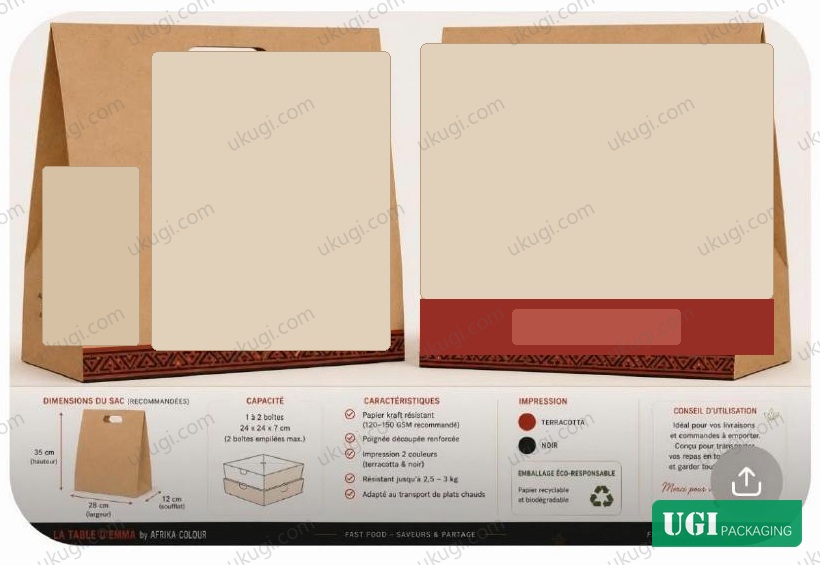
The reference image was useful for discussing shape and visual direction, but it could not be treated as the buyer’s approved design or as evidence that the same construction would meet the new project’s load.
Known information, missing inputs and quotation impact
| Known / still needed | Evidence or question | Why it changes the quotation |
|---|---|---|
| Known: two different size descriptions | The written brief says about 25 × 25 × 30 cm; the reference labels about 28 × 12 × 35 cm. | Face width, side gusset and height determine the dieline, paper consumption, print position, packing volume and freight. |
| Still needed: dimension convention | Confirm finished face width × side gusset × height, whether dimensions are external, and the allowed tolerance. | A square-looking size and a narrow-gusset carrier bag are not interchangeable structures. |
| Known: takeaway boxes and bottles | The product types are named, but their count, dimensions, total weight and arrangement are absent. | Load and fit affect bag dimensions, handle reinforcement, bottom reinforcement, paper selection and outer packing. |
| Still needed: use conditions | Will the bag encounter hot food, chilled bottles, condensation, grease, rain or extended carrying? | Moisture, grease, temperature and carrying duration can change the paper, coating, adhesive and validation plan. |
| Known: approximately 120–150 g/m² kraft paper | Confirm final grade, recycled-content preference, strength expectation and required declarations. | Grammage alone does not establish tensile strength, handle performance or suitability for the intended food-use conditions. |
| Known: two-colour concept | Confirm print sides, coverage, process, Pantone or approved colour references and whether unprinted kraft colour forms part of the design. | Ink count is only one cost input; coverage, registration, substrate and print method also matter. |
| Still needed: delivery basis | Destination city/postcode, Incoterm, door or port delivery, duty/tax requirement, route and target date. | Delivered price cannot be compared until the shipment basis and final carton volume are defined. |
For broader questions about food-use conditions, printing, sampling and quotation inputs, see the Food Packaging FAQ.
Artwork, dieline and digital mock-up are different deliverables
The buyer asked the supplier to create the final artwork from a visual reference and recommend the best branding size. That request is possible to assess, but only after the structure and design responsibility are separated.
What is a packaging dieline?
A dieline is the flat structural drawing used to define cutting, folding, gluing, side gussets, the die-cut handle and the bottom construction. The confirmed bag dimensions and manufacturing tolerances must come before final artwork placement.
What is packaging artwork?
Artwork is the visual content placed on the approved dieline: editable logo files, exact wording, colours, graphics, fonts and print positions. A screenshot or rendered reference can show intent, but it normally cannot supply the editable vectors, colour definitions or bleed needed for production.
What is a digital mock-up or proof?
A digital mock-up shows how the proposed design may look on the bag. It is used for review and approval, but it does not replace a structural sample, final prepress checks or the approved production file.
When is design work chargeable?
Placing supplied, usable assets on a factory dieline is different from recreating logos, developing illustrations, choosing a new visual system or writing packaging copy. Before work begins, the supplier and buyer should agree whether the task is dieline adaptation, artwork layout, file reconstruction or full creative design; the design fee, revision allowance, proof format and ownership of final files should be stated separately. No chargeable design work should begin without approval.
A factory-ready sequence for this project
- Confirm the packed products. List every box and bottle, dimensions, quantity, total loaded weight and arrangement.
- Confirm the bag size format. State face width × side gusset × height and whether the measurements are external.
- Select a provisional structure. Define the handle cut-out, handle patch, bottom reinforcement, side gussets and intended carrying conditions.
- Prepare the structural dieline. The factory develops or confirms the flat pattern and printable area from the approved dimensions.
- Define the artwork service. Supply editable logos and copy, or approve a separately quoted design scope.
- Approve colour and placement. Confirm print method, colour references, coverage, branding size and sides to print.
- Choose the sample level. A structural blank, digital mock-up or production-representative sample answers different questions.
- Confirm delivery details. Only then can packing volume, shipping route and delivered price be calculated on a consistent basis.
What this Case does and does not establish
This Case records the information supplied in one anonymized enquiry and explains why clarification is necessary before pricing. It does not establish a final paper grade, load capacity, food-contact status, print method, MOQ, sample price, production time or freight cost. It also does not claim that the pictured reference was manufactured, approved or tested by UGI. Those decisions require a confirmed specification, appropriate documents and project-specific validation.
Copy-and-send kraft paper bag RFQ template
A buyer can replace the brackets below and send the completed brief with product photographs, editable logo files and any compliance requirements.
Related UGI resources
Need help turning a visual reference into a quote-ready brief?
Send the reference together with the actual products, confirmed size convention, load, editable brand assets and delivery details. We will separate structure, artwork, sampling and production questions before a final quotation is issued.