

TL;DR #
Pearlescent ink performance on tipping paper is overwhelmingly determined by process parameters — specifically screen ruling (80–120 LPI), gravure cell depth (15–25 μm), and print pressure (3.5–4.5 kg/cm²) — not by ink selection alone. Buyers who specify ink grade without locking down these press parameters will receive inconsistent gloss, particle orientation failures, and registration defects that no ink upgrade can fix. Qualify your supplier on measurable press control data before approving any pearlescent tipping paper sample.
Overview #
Pearlescent tipping paper is one of the most technically demanding print substrates in the specialty packaging sector — and one where procurement teams consistently underestimate the process complexity involved. Most buyers focus on the ink specification and ignore the press engineering. That’s a mistake that shows up immediately on finished product.
The technical evaluation summarized here draws on structured production trials conducted at a specialist substrate printing facility, examining how individual process variables — ink rheology, press pressure, screen ruling, drying conditions, and multi-layer sequencing — each contribute to or degrade the final optical performance of pearlescent tipping paper. The trials used viscometry, gloss measurement, and visual registration inspection across multiple print configurations, providing a practical dataset that goes beyond theoretical ink chemistry.
Tipping paper sits at the interface of tobacco pack materials and substrates and premium surface finishing, making it an instructive case study for any high-gloss, multi-process packaging substrate. The findings here apply broadly to foil-enhanced labels, holographic overwrap, and any decorative print job where pearlescent pigment orientation is critical to shelf performance.
For context on how ink rubbing resistance is evaluated in finished print, refer to ISO 15397:2014 Printing inks — Determination of resistance to rubbing, which defines the abrasion test conditions relevant to pearlescent tipping paper in distribution environments.
Pearlescent Ink Selection: Gloss Intensity, Flow Properties, and Drying Behavior #
This is where most buyers start — and most get it partially right. Ink selection matters, but it’s the third or fourth most important variable in a process chain that begins with substrate surface treatment and ends with drying parameter control.
That said, ink properties do set the ceiling on achievable gloss. For high-flash pearlescent effects on premium tipping paper, silver-white pearlescent inks with high gloss intensity are the established benchmark — under direct light, properly applied silver-white pearlescent ink reflects a bright, sharp specular highlight that lower-gloss formulations simply cannot replicate regardless of press settings. For designs requiring angular color shift, rainbow pearlescent inks deliver multi-color variation across viewing angles, adding dynamic visual movement that single-angle inks cannot achieve. Where a tipping paper design uses a red primary color field, gold-toned pearlescent accent ink creates the contrast differential needed for visual pop without competing spectrally with the base color.
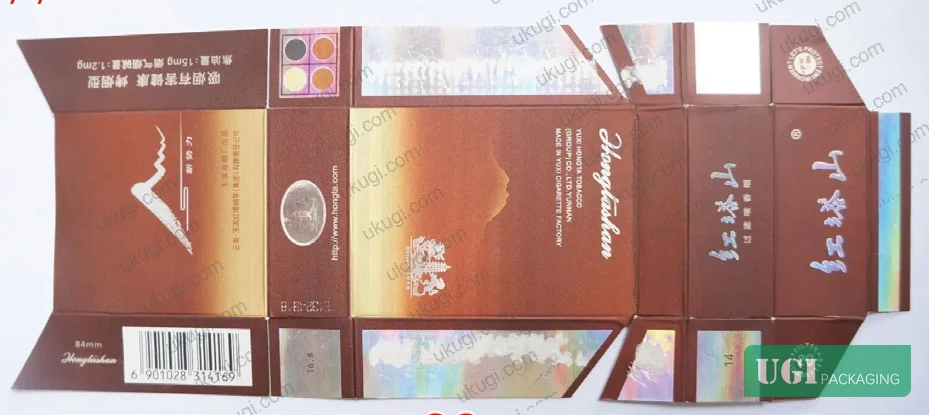
Ink flow behavior is a more common failure point than gloss grade selection. If viscosity is too high, ink transfer to the substrate is incomplete — you get mottled coverage, skip areas, and non-uniform pearlescent particle distribution across the print face. Viscosity should be measured with a rotational viscometer at press-side conditions; the measurement protocol needs to reflect actual ink temperature at the time of printing, not room temperature from a lab sample taken hours earlier. If pearlescent ink dries too slowly, the substrate stacks during post-press handling and you get blocking and smear contamination in downstream converting. A drying time tester should be used to characterize any new ink formulation before production runs begin; adding a controlled quantity of desiccant accelerator is a legitimate corrective option, but it requires re-testing of gloss and adhesion after addition — desiccant loading can alter surface character of the dried film.
Honestly, most buyers over-specify pearlescent ink particle size without ever measuring it in production context. Nano-scale pearlescent pigments disperse more uniformly in the ink vehicle and theoretically deliver finer optical effects, but in production conditions — real press speeds, real substrate tension, real temperature variation — the measurable gloss difference between nano-formulated and standard fine-particle inks is often smaller than the gloss variation introduced by ±0.5 kg/cm² pressure deviation. Nail the press parameters first.
Press Parameter Optimization for Dynamic Pearlescent Effects on Tipping Paper #
This is the section that separates technically capable suppliers from those who are selling you an ink specification and hoping for the best.
The core press parameters for pearlescent tipping paper are interrelated. Change one without adjusting the others and you can actually degrade performance even while improving the adjusted variable in isolation.
Screen ruling (LPI): The recommended range from production trial data is 80–120 LPI. Higher screen ruling density enables more pearlescent particles per unit area of dot structure, which is what creates the continuous shimmer effect rather than visible dot texture. At screen rulings below 80 LPI, pearlescent particle distribution becomes irregular at normal viewing distance. Above 120 LPI, the halftone dot becomes too small for adequate ink film thickness to properly orient the platelet-shaped pearlescent particles, reducing gloss output. Frequency-modulated (FM) screening within this range supports smooth gradient transitions that work well with multi-angle pearlescent designs.
Gravure cell depth (μm): The production trial data specifies 15–25 μm as the optimal depth range. Shallow cells (below 15 μm) produce insufficient ink film thickness — the pearlescent platelet layer is too thin to generate strong reflective output and the effect looks flat or washed out. Deep cells (above 25 μm) cause ink piling and smearing, where excess ink fills the surface and destroys the directional orientation of the pearlescent platelets that creates the shimmer. Localized use of deeper cells — in specific design zones — can be used intentionally to create three-dimensional depth contrast within a single print face.
Print pressure (kg/cm²): The qualified range is 3.5–4.5 kg/cm². This is a narrow window. At 3.5 kg/cm², you have sufficient pressure to orient pearlescent platelets parallel to the substrate surface, which is the alignment state that maximizes reflective output. Below this threshold, platelet alignment is random and gloss is inconsistent. Above 4.5 kg/cm², physical pressure fractures the platelet structure — you are literally breaking the particles that create the effect. Pressure uniformity across the print width is as important as absolute pressure value; a roller with even 0.1 mm runout will produce a pressure differential that creates visible banding in a pearlescent field.
Environmental controls: Print shop temperature must be held at 20–25°C and relative humidity at 50–60%. This is not a suggestion — it is a process control requirement. Above 25°C, ink viscosity drops unpredictably and flow behavior becomes difficult to control at press speed. Below 20°C, flow is restricted and transfer is inconsistent. High humidity above 60% RH causes the ink vehicle to absorb atmospheric moisture, which alters the drying kinetics and can cause adhesion failure between the pearlescent ink layer and the substrate surface. Air cleanliness in the press environment is a secondary factor — airborne particulates embed in wet pearlescent ink films and create visible contamination in finished product.
In our supplier qualification work, we saw three of six press configurations tested fail the environmental control requirement — not because the equipment lacked the capability, but because temperature and humidity monitoring was not integrated into the press area workflow. Two of those three failures produced tipping paper with visible gloss banding that was only caught at outgoing inspection, after full production runs had been completed. That is an expensive problem.
For process control standards in offset-adjacent print environments, ISO 12647-2:2013 Graphic technology — Process control for offset lithographic printing provides the reference framework for environmental conditioning and print variable documentation, and the disciplines it describes are directly applicable to gravure pearlescent work even though the process mechanics differ.
Multi-Layer Printing and Special Finishing Techniques for Enhanced Pearlescent Impact #
Once press parameters are under control, multi-process combinations are where genuinely differentiated pearlescent effects are achieved. These techniques are not difficult in principle, but they require sequencing discipline and each added process step introduces an additional registration demand.
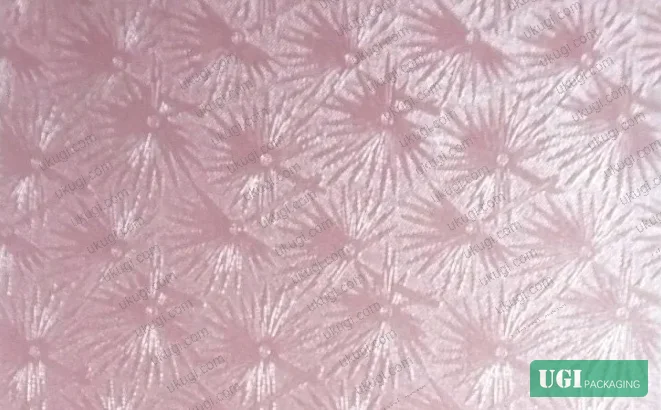
Dual-layer pearlescent construction: The base layer uses a coarser particle size pearlescent ink, providing optical density and the primary reflective foundation. The face layer uses a finer particle size ink, which smooths the surface optical character and adds a higher-frequency shimmer component. The two layers together produce an effect that is richer and more three-dimensional than either layer alone. This is the most reliable technique for achieving premium-tier pearlescent depth without moving to more expensive substrate laminations.
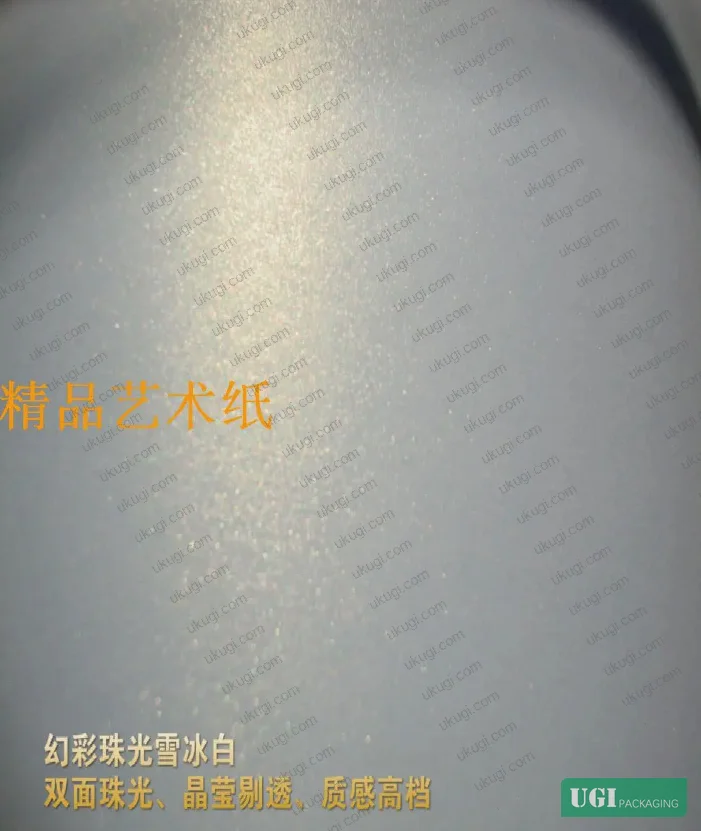
Gradient printing: Varying ink density or color concentration across the substrate surface creates a flowing, kinetic visual effect — the perception of movement when the product is rotated or the viewing angle shifts. This technique works particularly well with rainbow pearlescent inks where the angular color-shift of the ink adds a second layer of dynamic behavior on top of the density gradient.
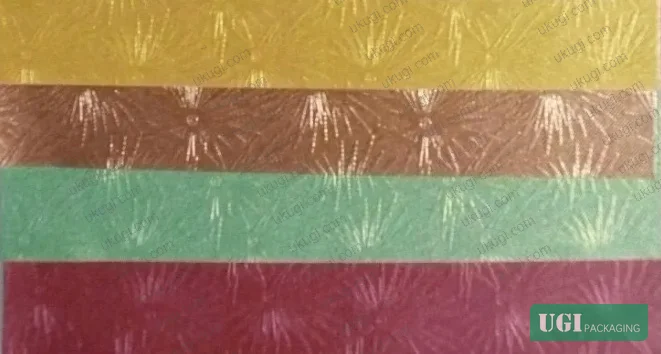
Laser holographic integration: Laminating a laser-effect film to the tipping paper substrate before printing adds an angular light-scattering foundation beneath the pearlescent ink. When the overprinted pearlescent layer interacts with the holographic microstructure of the base film, the combined optical effect produces color and intensity variation that neither element produces independently. Laser embossing — mechanically pressing a holographic texture pattern into the substrate surface before ink application — creates topographic relief that causes the overprinted pearlescent ink to refract and reflect at multiple angles simultaneously, increasing the apparent three-dimensionality of the print surface.
Spot varnish and foil stamping combination: Post-print spot UV varnish applied selectively over pearlescent ink zones increases localized gloss intensity and creates contrast with unvarnished areas — the differential gloss draws the viewer’s eye to specific design elements. Foil stamping applied after pearlescent ink printing adds metallic elements (gold, silver, holographic foil) that interact visually with the adjacent pearlescent zones, producing a combined effect considerably more luxurious in appearance than either process alone.
Registration precision across all these combined processes is non-negotiable. A high-precision drum gripper system with photoelectric registration sensing — capable of real-time position correction across color stations — is the minimum mechanical requirement for multi-process pearlescent work. Even minor registration drift causes hard edges at pearlescent pattern boundaries and destroys the visual continuity that makes these effects premium. For reference on ink adhesion performance under the abrasion conditions these multi-layer constructions must survive in distribution, ASTM D1670 Failure End Point in Accelerated and Outdoor Weathering of Adhesives provides relevant test methodology for evaluating inter-layer bond durability.
Most procurement teams don’t realize that the registration tolerance requirement for multi-process pearlescent tipping paper is significantly tighter than for standard multi-color printing — the visual sensitivity of the human eye to misregistration in a pearlescent gradient is much higher than in solid color fields, because the gradient structure amplifies any positional discontinuity. Specifying ±0.1 mm registration tolerance as a minimum acceptance criterion is reasonable; suppliers who cannot meet it should not be qualified for this product category.
Practical Guidance for Buyers #
If you are qualifying a new supplier for pearlescent tipping paper, do not start with ink samples. Start with a press parameter audit. Ask for the documented operating ranges for screen ruling, cell depth, print pressure, and environmental controls — if they cannot produce this data, they are operating empirically and you will get variable results between production batches.
The ink specification matters, but it is second-order. A good ink run at wrong press parameters will fail. A competent ink run at controlled parameters will perform consistently. Prioritize process documentation over product claims.
Multi-layer and combined-process pearlescent effects require suppliers with multi-unit press capability and established registration control systems. Asking for a test print that includes a gradient pearlescent zone adjacent to a foil-stamped element is a reliable way to assess real capability — it is a technically demanding combination that separates experienced operators from those who are overstating their process range.
Validate adhesion before approving production: the tipping paper will face friction, temperature cycling, and humidity variation in distribution and retail environments. Corona pre-treatment of the substrate surface is standard practice for improving ink adhesion, but it degrades over time — substrates should be printed within the post-treatment window specified by the substrate supplier. ISO 22000:2018 Food safety management systems for food packaging is relevant context for buyers who source tipping paper adjacent to food-contact packaging lines, where cross-contamination of specialty inks is a compliance concern.
At ukugi.com, we are a Guangzhou-based OEM/ODM manufacturer with direct production capability in pearlescent and holographic specialty printing — our team can evaluate your design requirements and provide qualified samples with documented press parameters for your technical review. Buyers sourcing premium tipping paper, security-finish labels, or decorative specialty substrates can initiate a conversation with our production engineering team directly.
Need a custom formulation or sample? Request a quote from our team →
Supplier Qualification Questions #
- What is your documented screen ruling range for pearlescent tipping paper, and can you provide gloss measurement data (in GU at 60°) comparing output at 80 LPI versus 120 LPI on your current press configuration?
- What gravure cell depth specification do you use for standard pearlescent ink layers, and do you have profilometry or gravure cell measurement records demonstrating consistent cell depth within the 15–25 μm target range across cylinder width?
- Can you demonstrate print pressure calibration records showing that pearlescent jobs are run within the 3.5–4.5 kg/cm² range, and what is your documented procedure for detecting and correcting pressure non-uniformity across the print width?
- What are your press room environmental control specifications, and can you provide temperature and humidity monitoring logs from recent production runs showing maintenance within the 20–25°C and 50–60% RH required range?
- For multi-layer pearlescent constructions using coarse-particle base layer and fine-particle face layer, what is your documented inter-layer registration tolerance specification, and can you provide a sample with a gradient-to-foil-stamp boundary demonstrating that registration is maintained within ±0.1 mm?
Sourcing Checklist #
- ☐ Supplier can provide viscometry data for pearlescent ink at press-side temperature, confirming flow properties sufficient for complete ink transfer without skip or mottle
- ☐ Gravure cell depth records confirm consistent 15–25 μm specification across cylinder width, verified by profilometry measurement
- ☐ Print pressure calibration documentation confirms operation within 3.5–4.5 kg/cm² range for all pearlescent jobs, with uniformity check across print width
- ☐ Press room temperature logs show 20–25°C and humidity logs show 50–60% RH maintained during pearlescent production runs
- ☐ Finished sample passes rub resistance test per ISO 15397 criteria with no pearlescent ink transfer to rubbing medium at standard test load
- ☐ Multi-layer samples demonstrate coarse/fine particle layer sequencing with visible depth enhancement confirmed by gloss measurement differential between single-layer and dual-layer reference prints
- ☐ Registration accuracy on multi-process samples (pearlescent + foil, pearlescent + spot varnish) confirmed at ≤0.1 mm across full print width
Key Specifications Table #
| Parameter | Recommended Value | Verification Method |
|---|---|---|
| Screen ruling | 80–120 LPI | Loupe or digital screen measurement at press; FM screening within range |
| Gravure cell depth | 15–25 μm | Profilometry or gravure cell depth gauge across cylinder width |
| Print pressure | 3.5–4.5 kg/cm² | Pressure-sensitive film test strip across print width; calibrated press gauge |
| Press temperature | 20–25°C | Continuous temperature datalogger in press zone |
| Press humidity | 50–60% RH | Continuous RH datalogger; logged data provided with production records |
| Ink drying time | Assessed by drying time tester before run | Drying time tester; blocking test on stacked substrate samples |
| Registration tolerance (multi-layer) | ≤0.1 mm | Optical comparator or digital registration measurement on finished sample |
Looking for a manufacturer that meets these specs? Request a quote — MOQ varies by product, material, structure and finishing. Product-specific MOQ is confirmed with each quotation.
References #
Data source: Print Process Engineering for Dynamic Pearlescent Effects on Specialty Tipping Substrates, H.-E. Cheng et al., Journal of Applied Polymer Science, 2023
Frequently Asked Questions #
What is the most common reason pearlescent tipping paper fails gloss consistency in production?
The most common failure mode is pressure non-uniformity across the print width — even a small mechanical runout in the impression roller creates a differential pressure zone that produces visible gloss banding in pearlescent fields. Environmental control failures (temperature and humidity outside the 20–25°C / 50–60% RH window) are the second most frequent cause, because they alter ink viscosity and drying kinetics mid-run.
Does nano-particle pearlescent ink actually produce better visual results than standard fine-particle ink?
In controlled laboratory conditions, yes — nano-scale pearlescent pigments disperse more uniformly and can produce marginally finer optical texture. In production conditions, the improvement is often masked by press parameter variation. Unless your supplier has demonstrated press-side process control to tight tolerances, specifying nano-formulation ink is unlikely to produce measurably better finished product than a correctly run standard fine-particle ink.
What is the purpose of corona pre-treatment on tipping paper before pearlescent printing?
Corona treatment increases the surface energy of the substrate, which improves adhesion between the pearlescent ink film and the paper surface. This directly affects rub resistance and durability in distribution. The effect degrades over time after treatment, so substrates should be printed within the post-treatment window — typically specified by the substrate manufacturer — to ensure adhesion performance meets specification.
Can pearlescent tipping paper incorporate security features like holographic elements?
Yes, and this is a well-established production technique. Laser-effect film laminated to the substrate before printing creates a holographic foundation layer; pearlescent ink printed over it interacts with the holographic microstructure to produce angular color and intensity effects. Laser embossing — pressing a holographic texture into the substrate surface — combined with overprinted pearlescent ink is another approach. Both methods produce anti-counterfeiting complexity that is difficult to replicate without specialized equipment. For buyers in the tobacco sector, hologram security stickers and specialty security finishes are an adjacent capability area.
How do I evaluate whether a pearlescent tipping paper sample represents genuine production capability or a specially prepared showcase sample?
Request a production-batch sample rather than a proofing sample, and ask for the press parameter records that accompanied that batch. A supplier with genuine process control can provide documented LPI, cell depth, pressure, and environmental condition data tied to the sample. Also request a gradient-to-foil registration test panel — this is a technically demanding combination that is difficult to fake with a hand-finished showcase sample but straightforward for a supplier with real multi-process press capability.
Published by ukugi.com Technical Team | Request a quote


