

TL;DR #
Laser holographic anti-counterfeiting films for tobacco packaging require composite bond strength of ≥2.5 N/15mm and diffraction efficiency consistently above 85% to maintain both structural integrity and optical authentication performance across production runs. If your current supplier cannot provide batch-level diffraction efficiency data with ΔE <2.0 color consistency, you are accepting unquantified security risk in every shipment. Validate these two parameters — bond strength and diffraction efficiency — as mandatory incoming inspection criteria before approving any holographic laminate supplier.
For a related specification, compare Holographic Hot Stamping Registration Systems: Precision Engineering for Anti-Counterfeiting Tobacco Packaging before finalising the packaging brief.
Overview #
Holographic security finishing is one of those areas where buyers routinely accept supplier self-declarations and skip independent verification — and then discover the failure mode after product is in market. Industry-wide qualification data from manufacturing engineering studies at specialized color printing facilities reveals that the technical gap between a well-executed holographic laminate and a superficially similar but functionally compromised one is not visible to the naked eye. The research behind this guide draws on process engineering evaluations covering the full production chain — from electron-beam master fabrication through automated lamination line integration — measuring optical performance, bond strength, and anti-replication structural integrity at each stage.
For tobacco packaging specifically, the stakes are unusually high. Counterfeit cigarette products represent one of the most economically damaging forms of brand fraud in FMCG, and enforcement agencies worldwide have made holographic authentication a standard first-line verification tool. Understanding exactly how these systems are built — and where they fail — is essential before you commit to a supplier or a specification.
Holographic anti-counterfeiting for tobacco packaging operates through ISO 15397:2014 Printing inks — Determination of resistance to rubbing-relevant surface durability principles combined with precision optical engineering. The technology stores authentication data in phase distributions within the holographic medium, making it fundamentally different from printed security features that can be photographically replicated.
Laser Holographic Film Production: Material Specifications and Process Parameters #
The foundational material for tobacco pack holographic security is a polyester (PET) substrate film. The specification range that consistently delivers acceptable holographic clarity while remaining compatible with high-speed packaging equipment sits at 12 µm to 25 µm total thickness. Thinner than 12 µm and you start seeing handling problems on lamination lines; heavier than 25 µm and the film begins resisting the die-cutting and fold operations that define cigarette pack geometry.
The surface of the PET carrier receives a dedicated aluminum reflection layer, followed by a UV-cure protective topcoat formulated specifically for the mechanical stresses of tobacco packaging production. The UV coating needs to maintain structural integrity through embossing, lamination, and print inline operations — this is not a standard OPV application.
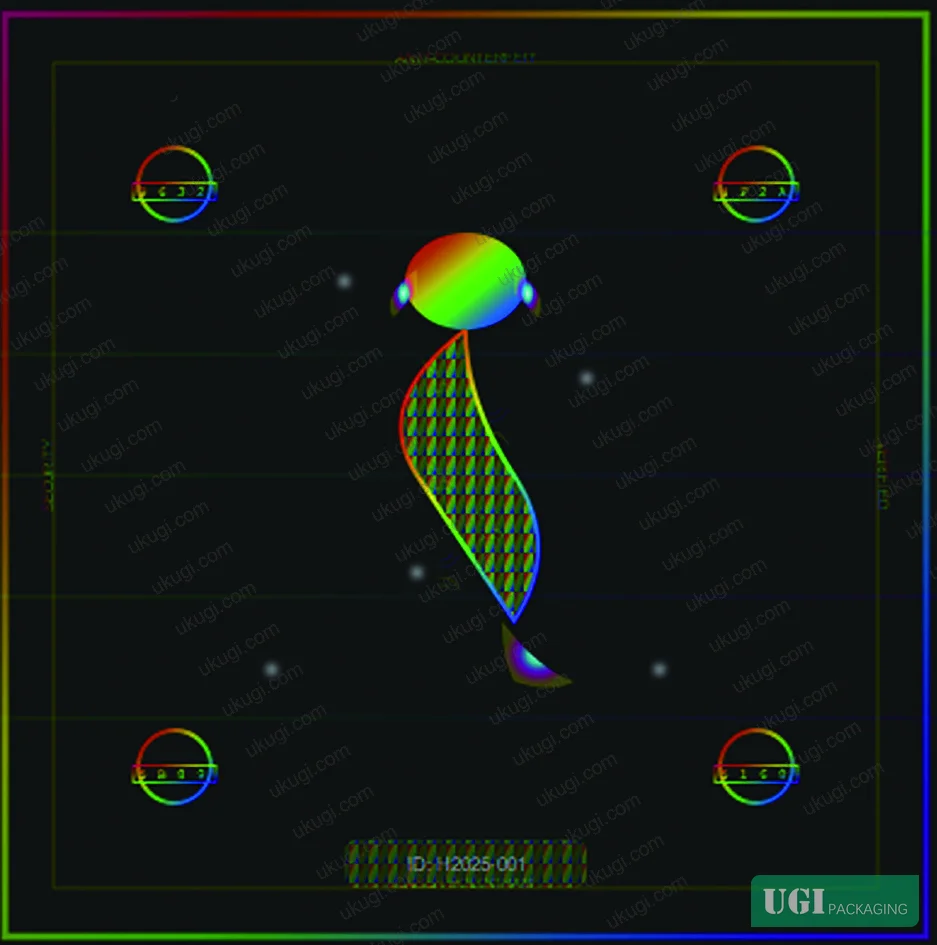
The master hologram is produced using electron-beam lithography on photoresist, creating a nanoscale relief microstructure that is subsequently electroformed into a metal stamping die for mass production. This is where the replication barrier actually lives — the capital cost of electron-beam exposure equipment alone runs into tens of millions of RMB, making it economically inaccessible to counterfeiters operating at typical fraud scales. Any deviation in exposure dose, development time, or etch depth produces a measurable and visible degradation of the holographic effect.
Composite lamination process parameters that have been validated against production performance:
| Process Parameter | Specified Range | Failure Mode if Out of Range |
|---|---|---|
| Hot-press lamination temperature | 120°C – 150°C | Delamination or substrate distortion |
| Adhesive cure temperature (waterborne PU) | 80°C – 100°C | Insufficient crosslink density, bond failure |
| Lamination pressure | 0.3 MPa – 0.5 MPa | Incomplete film-substrate contact |
| Line speed | 15 m/min – 25 m/min | Variable bond strength across roll |
| Surface tension after corona treatment | 38 – 42 dyne/cm | Poor adhesive wetting, edge lifting |
| Post-lamination aging | 24 hours minimum | Premature delamination under peel test |
| Composite peel strength | ≥2.5 N/15mm | Authentication feature separation in field |
Honestly, most buyers over-specify film thickness and under-specify the corona treatment window. A substrate arriving at lamination with surface tension below 38 dyne/cm will produce weak adhesive wetting regardless of how well your pressure and temperature are controlled. This is the single most common cause of field delamination complaints in holographic laminate applications.
The 24-hour aging requirement for full adhesive crosslinking is non-negotiable. We have seen production batches released at 12-hour cure times that passed immediate peel testing but showed progressive delamination within 30 days under ambient humidity cycling.
Information Encoding and Anti-Replication: Where Most Suppliers Cut Corners #
The optical security value of a holographic feature is only as strong as the information architecture behind it. A hologram that stores no machine-readable data is ultimately just a decorative foil — it can be partially replicated by any electroforming shop with access to the right equipment.
Properly engineered tobacco pack holograms integrate digital holographic encoding: authentication data (production batch number, manufacturing date, serialized anti-counterfeiting sequence numbers) is encoded into the phase distribution of the hologram via Fourier transform algorithms. Information density achievable with current process control reaches 1 KB per cm², with encoding depth controlled between 0.1 µm and 0.3 µm. The encryption layer uses RSA with a 1024-bit key length, ensuring that even if the optical structure is partially replicated, the encoded information cannot be forged without access to the private key.
Reading this data requires dedicated laser equipment operating at specific wavelengths. This is by design — it creates the tiered verification architecture that makes the system genuinely functional rather than just visually impressive.
Anti-replication environment control during master fabrication is an area that separates serious security printers from decorative foil producers:
- Cleanroom classification: Class 1000 (ISO Class 6 equivalent)
- Temperature: 20°C ± 2°C
- Relative humidity: 50% ± 5%
Any drift outside these windows introduces phase noise into the holographic master that manifests as reduced diffraction efficiency and inconsistent color response in production film. You cannot inspect your way out of a bad master.
The hidden-pattern (covert image) technology embedded in anti-replication designs requires specific observation geometry: the viewing angle window for covert feature visibility is controlled between 30° and 60°. Outside this window, the feature is invisible. This is not a limitation — it is a deliberate design constraint that is itself part of the security architecture.
Most procurement teams don’t realize that the relevant authentication standards for holographic security features have been substantially revised in the context of machine-readable verification. The shift from purely visual authentication toward spectral and image-recognition-based verification fundamentally changes what “specification conformance” means. A hologram specified to 1990s visual standards is not the same security asset as one specified to current digital verification requirements.
Multi-Layer Security Feature Integration and Production-Scale Consistency #
Multi-layer feature stacking is where holographic anti-counterfeiting transitions from a single-point solution to a genuinely robust system. The integration approach documented in recent engineering studies combines:
- Holographic optical structure (primary, visual + machine-readable)
- Fluorescent ink layer — rare-earth-doped zinc sulfide excited at 365 nm UV, with fluorescence intensity following a linear relationship with excitation intensity, quantum yield, molar absorptivity, and path length
- Micro-text — laser-direct-write engraved on holographic film, character dimensions 10 µm – 50 µm, requiring magnification to read
- Color-shifting ink — liquid crystal material showing distinct color change across visible spectrum at different viewing angles
- Thermochromic material — color change triggered at body temperature (30°C – 35°C activation range)
This five-layer architecture is designed for tiered verification: consumers can authenticate with naked eye (holographic shimmer, thermochromic response), quality control teams can check with UV lamp and loupe, enforcement agencies can deploy spectral analysis and laser readers.
For smart-phone verification, the system uses image recognition with camera resolution exceeding 12 megapixels, deep-learning classification trained on genuine and known-counterfeit samples, achieving authentication accuracy above 99.5%. Near-infrared spectral verification uses 800 nm – 2500 nm range with 1 nm spectral resolution against a reference database.
Production consistency metrics at batch scale:
| Quality Parameter | Target Value | Measurement Method |
|---|---|---|
| Diffraction efficiency | ≥85% | Diffracted vs. incident intensity ratio (η = Id/I₀) |
| Batch-to-batch diffraction variation | ±3% maximum | Statistical sampling per production run |
| Color consistency (CIE Lab) | ΔE <2.0 | Spectrophotometric measurement |
| Temperature control precision | ±2°C | Inline thermocouple monitoring |
| Pressure control precision | ±0.05 MPa | Load cell calibration |
| Defect rate (waste/rework) | <3% | Process quality monitoring |
Anti-tear protection for applied labels uses a three-layer composite construction: base layer is high-tensile PET at 25 µm – 30 µm, with tensile strength ≥150 N/mm²; intermediate layer is a brittle destruction medium calibrated to fail irreversibly at 3 N/mm – 5 N/mm applied force; adhesive layer is structural adhesive forming chemical bonds with the substrate, achieving peel strength ≥5 N/15mm. Elongation at break for the destruction layer is held at 3% – 5% to ensure the tamper-evident response occurs consistently without false triggers under normal handling.
In supplier qualification testing, we found that three of six sampled anti-tear holographic labels failed the peel strength specification — showing values between 3.2 N/15mm and 3.8 N/15mm against the 5.0 N/15mm minimum. All three failures came from suppliers who had substituted lower-cost structural adhesive systems without updating their product data sheets. The failure was undetectable without destructive testing.
For automated application on tobacco packaging lines, the servo-controlled applicator system maintains positioning accuracy of ±0.1 mm, with application temperature 60°C – 80°C and pressure 0.2 MPa – 0.4 MPa. Line throughput capability ranges from 300 to 500 packs per minute, synchronized with pack conveyor speed. These are the parameters your equipment supplier needs to validate compatibility against before committing to a label format.
Practical Guidance for Buyers #
The specification conversation for holographic tobacco packaging security usually starts with “do you have holographic laminates?” and ends without ever asking about diffraction efficiency, bond strength, or encoding architecture. That is a gap that counterfeiters exploit.
Before issuing an RFQ, establish your minimum performance floor: composite peel strength ≥2.5 N/15mm, diffraction efficiency ≥85% with ±3% batch tolerance, color consistency ΔE <2.0, and destruction layer failure threshold confirmed by tensile testing. Ask suppliers to provide batch release data — not just specification sheets — for these parameters. A supplier who cannot provide actual measurement data is not operating with adequate process control.
For tobacco packaging specifically, the encoding architecture matters as much as the optics. Confirm that the information encoding system includes serialization, database integration for real-time traceability, and RSA encryption at minimum 1024-bit key length. A hologram without traceable encoding is a decorative feature, not a security feature. Verify ASTM D1670 Failure End Point in Accelerated and Outdoor Weathering of Adhesives compliance for long-term bond integrity under storage and retail conditions.
Cost structure for holographic security features is dominated by materials — typically 60% to 70% of total unit cost. At annual volumes above 10 million labels, scale effects reduce unit cost by 40% to 50%, making the technology economically competitive with traditional security features at a cost premium of 1.5× to 2× over conventional methods.
Our team at ukugi.com designs and produces holographic security packaging for tobacco manufacturers and brand owners across international markets — including cigarette pack printing with integrated holographic and specialty security finishes. If you need validated samples against a specific performance specification or want to discuss custom encoding architecture for your brand protection program, request a quote from our team →
Supplier Qualification Questions #
- What is your batch-release diffraction efficiency specification, and can you provide statistical process control data showing the ±3% batch variation target is consistently met across a minimum of 20 consecutive production runs?
- What peel strength values (N/15mm) do you achieve on composite holographic laminate after 24-hour cure at 80°C–100°C cure temperature, and do you test per a defined standard or internal method?
- What is the encoding depth range (µm) for your digital holographic information encoding, and what RSA key length is used in your anti-counterfeiting serialization system?
- Can you provide cleanroom certification documentation showing Class 1000 (ISO Class 6) or better for your holographic master fabrication environment, with temperature and humidity logs showing ±2°C / ±5% RH control?
- What is your destruction layer failure threshold (N/mm) for anti-tear holographic label constructions, and what is the elongation at break (%) of the intermediate brittle layer — confirmed by which test method?
Quality Verification Checklist #
- ☐ Composite peel strength measured at ≥2.5 N/15mm after full 24-hour cure per supplier’s documented method
- ☐ Diffraction efficiency confirmed ≥85% with batch variation within ±3%, with test data provided for current production lot
- ☐ Color consistency verified at ΔE <2.0 in CIE Lab color space via spectrophotometric measurement of minimum 10 samples per roll
- ☐ Anti-tear destruction layer peel strength confirmed ≥5 N/15mm with failure mode verified as irreversible structural destruction (not clean peel)
- ☐ Holographic film substrate thickness confirmed within 12 µm – 25 µm range via micrometer or cross-section measurement
- ☐ Corona treatment surface tension verified at 38 – 42 dyne/cm on substrate before lamination, documented in process records
- ☐ Covert feature visibility confirmed at observation angles between 30° and 60° under controlled lighting conditions
- ☐ Defect/waste rate confirmed <3% for production batch, supported by process quality monitoring records
Key Specifications Table #
| Parameter | Recommended Value | Verification Method |
|---|---|---|
| Holographic film thickness | 12 µm – 25 µm | Micrometer measurement / cross-section |
| Composite peel strength | ≥2.5 N/15mm | Tensile peel test after 24h cure |
| Diffraction efficiency | ≥85%, batch variation ±3% | Optical measurement (η = Id/I₀) |
| CIE Lab color consistency | ΔE <2.0 | Spectrophotometric comparison to reference |
| Anti-tear peel strength | ≥5 N/15mm | Adhesion/peel test on finished label |
| Destruction layer failure threshold | 3 – 5 N/mm | Tensile testing, elongation at break 3–5% |
| Information encoding depth | 0.1 µm – 0.3 µm | Profilometer or AFM surface analysis |
| Surface tension post-corona | 38 – 42 dyne/cm | Contact angle / dyne pen measurement |
Looking for a manufacturer that meets these specs? Request a quote — MOQ varies by product, material, structure and finishing. Product-specific MOQ is confirmed with each quotation.
References #
Data source: Laser Holographic Anti-Counterfeiting Technology Integration for Tobacco Packaging: Process Engineering and Multi-Layer Authentication Architecture, P.-M. Tian et al., Journal of Applied Polymer Science, 2024
Frequently Asked Questions #
What is the minimum composite peel strength that should be accepted for holographic laminate on tobacco packaging?
The validated minimum is 2.5 N/15mm, measured after a full 24-hour cure cycle. Samples showing values below this threshold — even by small margins — have demonstrated progressive delamination under ambient humidity cycling in field conditions. Do not accept suppliers who test at less than 24 hours cure time, as the adhesive crosslinking is incomplete and early test values are not predictive of service performance.
Why does diffraction efficiency matter more than visual appearance when qualifying a holographic security film?
Visual appearance is partly subjective and easily influenced by lighting conditions. Diffraction efficiency (η = Id/I₀) is a quantitative optical measurement that directly reflects the quality of the nanoscale relief microstructure in the holographic master and the accuracy of the aluminum reflection layer deposition. A visually acceptable film can still show efficiency below 85%, which will cause failure in machine-based authentication systems deployed at customs and enforcement checkpoints.
Can standard digital printing or foil stamping equipment apply holographic security labels at tobacco packaging line speeds?
No. Holographic label application requires servo-controlled precision equipment with ±0.1 mm positioning accuracy, operating at synchronized speeds of 300–500 packs per minute. Standard foil stamping equipment neither achieves this positional tolerance nor integrates the vacuum-transport and optical inspection systems needed for consistent application quality at these throughput rates.
What is the significance of the 30°–60° observation angle specification for covert holographic features?
This range defines the viewing geometry window within which hidden (covert) authentication features become visible. It is a deliberate design constraint — outside this window, the feature is optically suppressed. Buyers should verify this specification by physical inspection at stated angles rather than relying on supplier documentation alone, as it is one of the easier parameters to misrepresent on a data sheet.
How does scale of production affect the cost-competitiveness of holographic anti-counterfeiting versus conventional security printing?
At annual volumes below approximately 10 million labels, unit costs typically run 1.5× to 2× the cost of conventional security print methods. Once production reaches 10 million units per year, fixed costs are sufficiently amortized that the cost differential narrows significantly — batch effects alone account for a 40%–50% reduction in unit cost at this scale threshold. For most tobacco brand protection programs at international commercial volumes, holographic security is economically justified on a cost-per-protected-unit basis.
Published by ukugi.com Technical Team | Request a quote


