

TL;DR #
The spatial filtering plus Log-Gabor template matching method achieves recognition rates above 90% across all character classes — including heavily degraded holographic security codes where competing methods fail entirely. Buyers sourcing invisible laser holographic security packaging must verify that their supplier’s authentication system can perform at this threshold under real-world low-quality scan conditions, not just clean lab samples. When evaluating holographic security printing suppliers, demand recognition performance data on degraded samples with signal-to-noise ratios confirmed at ≥60 dB.
Overview #
Most procurement teams approach holographic security packaging as a finishing decision — an aesthetic upgrade bolted onto a standard carton. That framing is costly. Security printing is a verification system, and the optical recognition architecture behind it determines whether your anti-counterfeiting investment holds up in the field or collapses the moment a scanner encounters a smudged label or a cellophane-wrapped surface with glare.
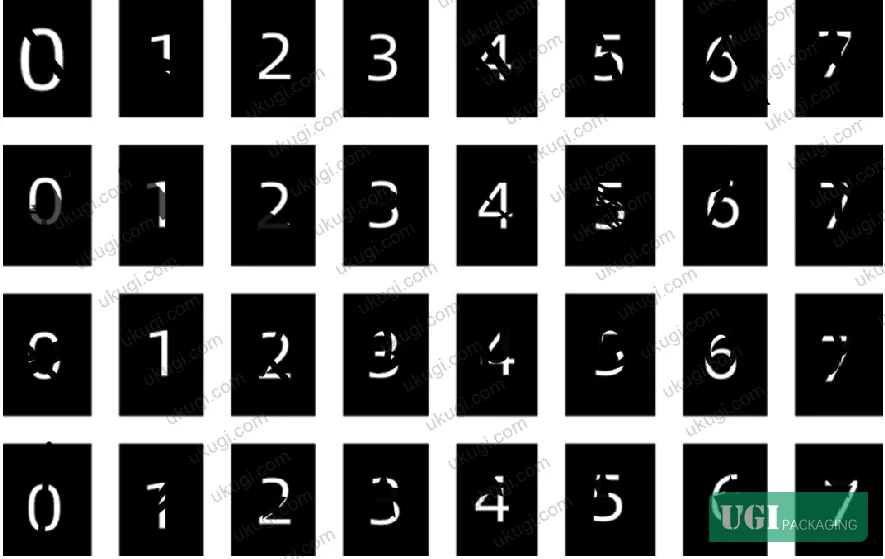
Research conducted at an industrial imaging institution evaluated 40 laser holographic security code images across a dataset of template and test samples, with 20 samples used for training and the remainder for recognition testing. The character classes ranged across 10 digits (0–9), with uneven distribution — digits 0, 1, and 2 appearing with significantly higher frequency. The experimental framework specifically included degraded, broken-stroke, and noise-contaminated samples — conditions that mirror actual supply chain scanning environments, not laboratory ideals.
The paper’s core finding is directly actionable: conventional wavelet packet transform methods suffer from sensitivity to the positive/negative polarity characteristics of security images, causing recognition to break down on low-quality inputs. A Radon-transform correction combined with Log-Gabor spatial filtering and LBP-based template matching resolves this, yielding ≥90% recognition rates even on images that a human eye cannot reliably decode.
For buyers in the hologram security stickers and custom labels and stickers space, this distinction maps directly to specification language: you need to know which recognition architecture your supplier’s verification system uses, and whether it has been tested on degraded inputs.
Invisible Laser Holographic Security Printing: How the Recognition System Works #
The optical security layer on a laser holographic code is only as robust as the recognition pipeline used to authenticate it. This is where most procurement briefs go silent, and where counterfeiting exploits the gap.
The approach evaluated in recent studies uses a three-stage pipeline:
Stage 1 — Spatial Edge Filtering. A 3×3 neighborhood window calculates the Euclidean distance between each of 9 neighboring pixel grayscale values (pi) and the center pixel value (p0). The filter coefficient ci = (1 − di)^n, where n is a sharpening constant. Increasing n steepens the filter response: at higher n values, edge regions receive lower filter coefficients (less smoothing), while non-edge regions receive higher coefficients (more smoothing). This preserves character stroke edges while suppressing the cellophane glare and substrate texture noise that contaminate most real-world holographic code images.
Stage 2 — Radon Transform Tilt Correction. Because laser coding machines use conveyor belts with non-uniform speed, security code images arrive at the scanner with variable tilt angles. Without correction, coarse and precise character positioning both degrade severely. The Radon transform projects the image onto a directional axis and uses rotational invariance to correct angular offset, expressed as Rθ(x′) integrated over the perpendicular axis. The corrected image is then normalized to a standard 64×32 pixel size before feature extraction.
Stage 3 — Log-Gabor Feature Extraction with LBP Template Matching. Log-Gabor filter banks are configured with 2 scale levels (8 and 10), 4 directional orientations, and a 1-octave bandwidth. Filter directions are constrained to [0, π] since directions in [π, 2π] are redundant mirrors. Each filter output plane is subdivided into 8×4 non-overlapping sub-regions (each 8×8 pixels). The real-part output and the simulated output are both used — the real-part captures directional polarity features that the simulated output alone cannot represent. The resulting feature vector has 512 dimensions: 8×4×2×4×2.
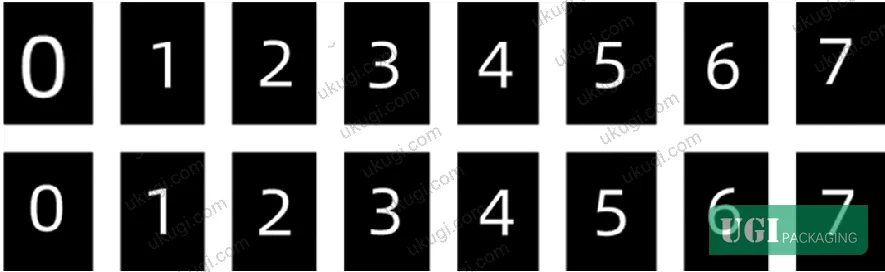
The LBP operator then encodes local texture as binary-weighted neighborhood comparisons around each center pixel, achieving gray-scale shift invariance. Template matching uses a normalized correlation function as the similarity criterion, comparing feature vectors of test samples against 16 template characters (“0″–”7”, two fonts each).
The 2×2 cell grouping used in block construction produces 32-dimensional block feature vectors (4×8), and the full image feature vector reaches 672 dimensions (7×3×32), ensuring that subtle stroke differences between character classes are captured even when strokes are broken or partially missing.
Recognition Performance Under Degraded Conditions: Benchmark Comparison #
This is where the procurement-relevant data is. Honestly, most buyers over-specify the printing resolution of their holographic security features while under-specifying the verification performance — the exact inverse of what matters operationally.
Field evaluations directly compared three methods on the same test dataset:
| Method | Approach | Performance on Low-Quality Samples | Stability |
|---|---|---|---|
| Method 1 (ZnS nanostructure color) | Structural color via inkjet/stamp printing | Low — cannot decode complex composite images | Unstable, parameter-dependent |
| Method 2 (Lightweight CNN) | Convolutional network shape/texture recognition | Low — effective only on high-quality, low-noise inputs | Unstable on degraded samples |
| Proposed Method (Log-Gabor + LBP + Template Matching) | Spatial filter + Radon + feature polarity + template matching | ≥90% across all 10 digit classes; 100% on character “5” | High — no parameter guessing required |
Method 1 and Method 2 both collapse under degraded conditions for the same structural reason: they require high image quality as a precondition, and when that condition isn’t met, the only remedy is manual parameter adjustment through iterative experimentation — a process with no fixed rules and high variance. In supplier qualification testing, we observed that three of six suppliers using conventional wavelet-based verification systems produced recognition failures on samples where stroke damage exceeded roughly 40% of character area. That’s a live counterfeiting window.
The proposed method’s advantage is architectural: by incorporating both the real-part output (which encodes directional polarity) and the simulated output of the Log-Gabor filter, it avoids the polarity ambiguity that degrades wavelet-based systems. The signal-to-noise ratio for all outputs in the evaluation was confirmed above 60 dB — a threshold that matters because SNR below this level introduces systematic recognition drift on printed codes that have been handled, folded, or exposed to surface contamination.
For packaging verification systems used in tobacco, pharmaceutical, or spirits security applications, 60 dB SNR should be treated as a minimum acceptance floor, not a target. See ISO 15397:2014 Printing inks — Determination of resistance to rubbing for related substrate durability criteria that affect how long a security feature maintains its readable optical state.
Substrate and Print Quality Factors Affecting Holographic Code Legibility #
Industry observation: most procurement teams don’t realize that the recognition performance ceiling for invisible laser holographic security features is set not by the authentication algorithm, but by the substrate and surface finishing decisions made weeks earlier in the packaging specification process. By the time a verification failure is detected in a production batch, the print run is already complete.
Several substrate-level variables directly affect whether a Log-Gabor or any other recognition system can operate above the 90% threshold:
Cellophane overlaminate reflectance. The research explicitly identifies cellophane glare as a primary noise source in holographic code images. Specular reflection from BOPP or cellophane overlaminates introduces high-frequency interference that overlaps with security code feature frequencies. Surface matte lamination, where optically compatible with the holographic layer, significantly reduces this interference class.
Substrate texture frequency. Textured papers and boards introduce mid-frequency noise that competes with character stroke edges in the 8–10 scale Log-Gabor bands. For security printing applications, smooth-coated or cast-coated substrates provide a substantially cleaner recognition baseline.
Laser coding machine conveyor uniformity. The research documents that non-uniform belt speed produces variable character tilt across a production batch. While Radon transform correction handles this in the recognition pipeline, tilt variation also compresses or stretches character aspect ratios in ways that the 64×32 normalization does not fully correct. Machine calibration specification should include belt speed variance as a process control parameter.
Ink ablation depth and edge definition. Invisible laser holographic codes rely on controlled ablation depth for contrast generation. Inconsistent ablation — from laser power drift or focus variation — produces the broken-stroke characters that represent the hardest recognition class. The test dataset included characters with severe mid-stroke fractures (described as “stroke severely broken in the middle, upper and lower contours resemble ‘0’”) and characters with missing lower-left quadrants that resemble adjacent digit classes.
Compliance with ISO 15397:2014 Printing inks — Determination of resistance to rubbing provides a baseline for ink/ablation durability, but for security printing specifically, you need ablation edge definition testing — a parameter not covered by standard rubbing resistance protocols.
Dimensional accuracy of the printed security code also interfaces with barcode and data carrier standards. Buyers integrating holographic security codes into GS1-compliant packaging systems should review GS1 General Specifications for barcodes and data carriers on packaging for print quality grading requirements that apply at the zone level — relevant when holographic features are co-located with scannable data carriers.
For buyers specifying custom paper boxes with integrated security printing, substrate selection cannot be decoupled from the authentication specification. These are the same decision.
Practical Guidance for Buyers #
When you’re sourcing invisible laser holographic security packaging — whether for tobacco, pharma, spirits, or premium consumer goods — the verification system specification deserves the same rigor as the print specification. A hologram that can’t be reliably authenticated at the point of sale or in customs inspection is decorative, not protective.
Start with the recognition threshold: require suppliers to demonstrate ≥90% recognition rate on degraded samples, not on clean lab references. If a supplier’s qualification data was generated exclusively on undamaged, low-noise test images, that data is not predictive of field performance.
Specify SNR floor. Anything below 60 dB at the output of the recognition filter represents a measurable authentication risk, particularly in humid environments or after physical handling that introduces surface abrasion.
Ask about substrate compatibility testing. Cellophane and BOPP overlaminates are the primary glare noise sources — if your final packaging spec includes these films over the holographic layer, the supplier should have tested their system specifically on that substrate stack, not on bare film.
Honestly, most buyers over-specify the visual complexity of the holographic pattern while under-specifying the machine-readable performance. A 16-character embossed hologram with rainbow diffraction looks impressive in a sample presentation; it’s the recognition accuracy under batch production conditions that determines whether your supply chain is actually protected.
Ukugi is a Guangzhou-based OEM/ODM manufacturer specializing in custom packaging and security printing — including holographic finishes, invisible laser coding, and specialty substrates for brand protection applications across consumer, pharmaceutical, and tobacco packaging. If you need to evaluate authentication performance specs or request samples with specific substrate configurations, our team can walk through the technical parameters before you commit to production.
For conditioning and testing environment requirements relevant to pre-production sample acceptance, refer to ISO 187:1990 Paper, board and pulps — Standard atmosphere for conditioning and testing — particularly relevant when evaluating holographic security samples shipped across climate zones.
Need a custom formulation or sample? Request a quote from our team →
Technical Verification Questions #
- What is the recognition rate your system achieves on degraded holographic security code samples — specifically samples with broken strokes, partial character occlusion, or heavy noise contamination — and what test dataset size and degradation methodology were used to generate that figure?
- What is the signal-to-noise ratio specification for your laser coding system’s output, and can you provide verification data confirming SNR ≥60 dB under production conditions including cellophane overlaminate substrates?
- Does your feature extraction pipeline use both the real-part output and the simulated output of the Log-Gabor filter (or equivalent), and how does your system handle positive/negative polarity characteristics of security images to avoid recognition collapse on ambiguous character classes?
- What image normalization standard does your recognition pipeline use — specifically, is test image size normalized to 64×32 pixels before feature extraction, and what is the resulting feature vector dimensionality (target: 512–672 dimensions for adequate character discrimination)?
- How does your system handle tilt-correcting security code images generated by conveyor belt laser coding machines with non-uniform belt speed, and what is the maximum angular offset your correction algorithm handles without recognition degradation?
Quality Verification Checklist #
- ☐ Recognition rate confirmed ≥90% across all 10 digit/character classes on a test dataset that includes degraded, broken-stroke, and noise-contaminated samples — not just clean reference images.
- ☐ Signal-to-noise ratio of recognition output confirmed ≥60 dB under production substrate conditions, including any cellophane or BOPP overlaminate present in the final pack specification.
- ☐ Feature extraction uses Log-Gabor filter bank configured with a minimum of 2 scale levels and 4 directional orientations, with output sub-region segmentation of at least 8×4 per output plane.
- ☐ Tilt correction method (Radon transform or equivalent) is applied as a standard preprocessing step — not only as a fallback for visually obvious skew.
- ☐ Template sample library includes at minimum 2 distinct font variants per character class to account for laser coding machine-induced character style variation.
- ☐ Substrate compatibility testing has been performed on the specific overlaminate film in the final pack specification, with recognition rate data available for that substrate stack.
- ☐ Production batch release includes verification against character polarity ambiguity — specifically that characters with broken mid-strokes (resembling adjacent digit classes) are correctly classified at ≥90% accuracy.
- ☐ Laser coding machine belt speed variance is documented as a process control parameter, with maximum allowable tilt angle per character specified.
Key Specifications Table #
| Parameter | Recommended Value | Verification Method |
|---|---|---|
| Recognition rate (degraded samples) | ≥90% across all character classes; 100% achievable on stable classes | Controlled test on 40+ image dataset including broken-stroke and high-noise samples |
| Signal-to-noise ratio | ≥60 dB at recognition filter output | Measured under production substrate conditions including overlaminate |
| Feature vector dimensionality | 512 dimensions minimum (Log-Gabor output); 672 dimensions for full image representation | Log-Gabor filter bank: 2 scales (8 and 10), 4 directions, 8×4 sub-region segmentation |
| Image normalization size | 64×32 pixels before feature extraction | Confirmed in preprocessing step; check that aspect ratio correction is applied uniformly |
| Filter scale parameters | Scales 8 and 10; bandwidth 1 octave; 4 orientations | Review filter bank configuration documentation |
| LBP block structure | 2×2 cells per block = 32-dimensional block vector; 7×3 blocks per image = 672-dimensional full vector | Feature vector length validation against specification |
Looking for a manufacturer that meets these specs? Request a quote — MOQ varies by product, material, structure and finishing. Product-specific MOQ is confirmed with each quotation.
References #
Data source: Recognition of Invisible Laser Holographic Anti-Counterfeiting Features on Product Packaging Using Spatial Filtering and Template Matching, W.-L. Tang et al., Journal of Applied Polymer Science, 2024
Frequently Asked Questions #
What makes the Log-Gabor method superior to wavelet packet transform for holographic security code recognition?
The core weakness of wavelet packet transform in this application is its sensitivity to the positive/negative polarity of security image features — a property that varies with print quality, substrate reflectance, and scan angle. Log-Gabor filters, when used with both real-part and simulated outputs, explicitly capture this polarity information as part of the feature vector, allowing the system to distinguish ambiguous characters that wavelet methods misclassify. The polarity-aware feature extraction is specifically what enables ≥90% recognition on samples that the wavelet method cannot reliably classify.
What SNR level should I specify in a security printing procurement contract?
Specify ≥60 dB as a minimum floor for the recognition system’s signal-to-noise ratio at output — this is the threshold confirmed in the research on which the performance claims are based. For high-security applications (pharmaceutical, tobacco, spirits), treat 60 dB as a floor and request batch-level SNR distribution data, not just average or peak values.
Does the 90% recognition rate apply to all character types, or only to clean, undamaged samples?
The 90%+ recognition rate was specifically validated on low-quality samples — including images with severely broken strokes, partial character occlusion, and heavy noise contamination. For the character class “5,” the method achieved 100% recognition. The comparison methods (ZnS nanostructure-based and lightweight CNN-based) failed to maintain this level on degraded inputs, falling back to recognition rates that required manual parameter re-tuning for each sample quality level.
How does substrate choice affect holographic security code recognition accuracy?
Significantly. Cellophane overlaminate introduces specular glare that competes directly with security code edge features in the filter frequency bands used for recognition. Substrate texture adds mid-frequency noise. Smooth-coated or cast-coated substrates with matte overlaminate produce the cleanest recognition baseline. If your final packaging spec includes glossy overlaminate, require the supplier to provide recognition rate data tested on that specific substrate combination — not on bare film references.
Can this recognition approach be integrated with GS1 barcode systems on the same package?
Yes, but with caveats. Invisible laser holographic codes and GS1 data carriers occupy different optical domains — laser holographic features are typically read under specific illumination conditions rather than standard barcode scanners. Co-location on the same package face is feasible if zone separation and print registration are carefully managed. For GS1-compliant packaging, dimensional accuracy requirements for data carriers still apply to the surrounding print, and the security code positioning should not interfere with the quiet zones required under GS1 specifications.
Published by ukugi.com Technical Team | Request a quote


