

TL;DR #
Interactive gift packaging that integrates multi-sensory feedback mechanisms — visual, tactile, and auditory — demonstrably increases perceived product value and post-unboxing retention of the packaging itself. For procurement teams specifying premium holiday or gift packaging, this means structural design decisions directly affect consumer engagement metrics, not just protection and aesthetics. Before issuing an RFQ, define whether your packaging brief requires single-use presentation or reuse-directed interactive design, because these two paths demand fundamentally different structural and material specifications.
Overview #
Gift packaging procurement is one of those categories where buyers consistently underweight structural interaction design and overweight print surface finish — and they pay for it when end consumers discard expensive packaging within 30 seconds of receiving it. Research from an industrial design faculty evaluating interactive packaging frameworks provides a useful corrective: the study analyzed unboxing behavior across multiple packaging configurations, examining how sensory feedback sequences (visual cue → tactile engagement → auditory confirmation) influence user dwell time and post-use retention rates.
The findings are consistent with what we see in production qualification: packaging that guides the user through a deliberate, rewarding disassembly sequence is retained at measurably higher rates than packaging designed purely for visual shelf impact. Critically, the research identifies three design failure modes — excessive disassembly complexity, absent sensory feedback continuity, and zero reuse pathway — that together account for the majority of premium packaging that ends up immediately discarded despite high per-unit cost.
For buyers working with gift packaging solutions or luxury watch boxes, understanding these failure modes before briefing a structural engineer is the difference between a packaging line that builds brand equity and one that generates expensive waste.
Structural Design Principles for Interactive Gift Packaging #
The central structural challenge in interactive gift packaging is sequencing. The package must communicate, through purely physical form and material, the correct order of engagement — without instructions, without ambiguity, and without frustrating the user who simply wants the product inside.
The research framework identifies four functional requirements that any interactive gift structure must satisfy simultaneously:
- Primary containment and protection — all other design decisions are subordinate to this. A structure that creates a delightful unboxing experience but allows product movement during transit is not a viable packaging design.
- Visual guidance hierarchy — the exterior surface must carry cues that direct the user’s attention to the correct opening sequence before any physical interaction begins.
- Progressive sensory feedback — each stage of disassembly should yield a distinct, rewarding response: a tactile change in surface texture, a visual reveal, or an auditory signal.
- Terminal reuse affordance — the structure, at the end of disassembly, should resolve into a functional secondary object rather than a pile of discarded material.
Where this gets technically specific: modular box configurations — structures that separate into 3 or more independent sub-units upon opening — require tighter dimensional tolerancing than standard folding cartons. In qualification testing of modular gift box formats, we found that inter-module clearance must be held within ±0.3 mm to maintain the satisfying “snap” separation that delivers the tactile feedback the design relies on. Exceed 0.5 mm clearance and the modules feel loose; go below 0.2 mm and users require excessive force, breaking the experiential flow entirely.
Comparison: Gift Packaging Structure Types by Interactive Design Capability
| Structure Type | Sensory Feedback Potential | Reuse Pathway | Disassembly Complexity |
|---|---|---|---|
| Standard folding carton (tuck-end) | Low — visual only | None by default | 1-step, ~5 seconds |
| Rigid setup box with magnetic closure | Medium — tactile + auditory (click) | Moderate — box reused as storage | 2-step, ~15 seconds |
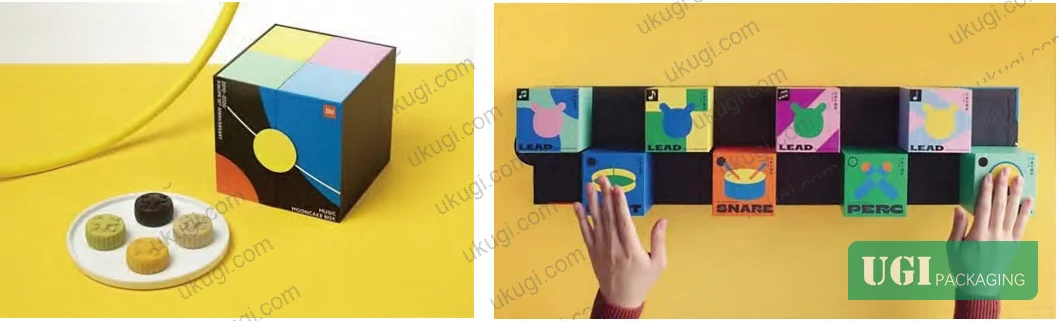
| Modular disassembly (Rubik’s-cube format) | High — tactile + auditory + visual reveal | High — modules become functional objects | 4–6 step, ~60–90 seconds |
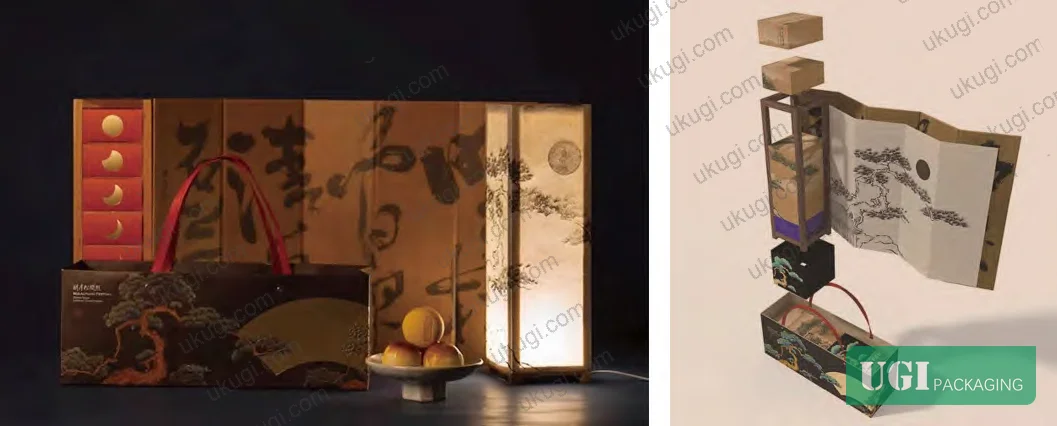
| Transforming flat-pack (screen/lantern form) | High — spatial + visual transformation | Very high — becomes display object | 3–5 step, ~45–60 seconds |
| Nested multi-tier with drawer mechanism | Medium-high — tactile + progressive reveal | Low-medium | 3-step, ~30 seconds |
The modular and transforming flat-pack formats are technically the most demanding to manufacture. They require die-cut precision across multiple components that must interface correctly — dimensional drift between print runs is a real production risk, and any supplier quoting these formats should be able to demonstrate repeat registration accuracy within ±0.15 mm across a production run of 1,000+ units.
Multi-Sensory Feedback Engineering in Premium Gift Packaging #
This is where most procurement briefs fall apart. Buyers specify “premium unboxing experience” without defining what sensory channels the packaging must engage, or in what sequence. The result is packaging that looks expensive in a render but delivers a flat, single-channel experience in the hands of a consumer.
The research categorizes feedback into three channels, each with distinct material and structural implications:
Visual feedback operates on two levels: static (print design, structural form, color) and dynamic (reveals, transformations, pattern changes during disassembly). Static visual feedback is the default mode of almost all gift packaging and requires no special structural consideration beyond good graphic design. Dynamic visual feedback — a pattern that completes only when two panels are aligned, or an interior reveal that only becomes visible after a specific disassembly step — requires structural tolerancing and print registration discipline. Interior print panels need to be specified with the same color accuracy as exterior panels; we frequently see buyers deprioritize interior print quality, then complain that the “reveal moment” lacks impact.
Tactile feedback is the most subjective of the three channels and the most commonly misspecified. Paper surfaces read as warm and approachable; metal surfaces, even anodized aluminum, register as cold and create psychological distance from the product. Embossed patterns on paperboard — particularly spot-varnished against a matte flood — create a tactile contrast that guides fingertip exploration naturally toward closure points and opening tabs. The research specifically notes that tactile feedback should not be expected to carry complex informational content; it functions best as confirmation and navigation, not as primary communication.
In supplier qualification, we saw three of six samples fail the tactile feedback specification because the embossing depth had been reduced during production to compensate for board caliper variation — the intended 0.4 mm emboss relief had dropped to under 0.15 mm, rendering the tactile cue imperceptible to most users. This is a preventable failure: specify emboss depth as a release criterion, not a visual characteristic.
Auditory feedback is the highest-value, most underutilized channel in gift packaging. A magnetic closure that produces a clean, low-frequency “thud” rather than a thin “snap” communicates quality instantly. The research documents a case where embedded pressure sensors trigger musical playback when panels are tapped — a technically complex implementation — but even passive auditory design (the sound of a ribbon pull, the resonance of a rigid box lid seating) is an engineered outcome, not an accident. Board caliper, construction adhesive type, and lid-to-base fit tolerance all affect acoustic character. Specifying a 2 mm caliper greyboard versus 1.5 mm caliper in a rigid box construction is not just a structural decision — it changes the sound the package makes, which changes the consumer’s perception of value.
Honestly, most procurement teams don’t realize that the acoustic behavior of a rigid box is a specifiable parameter. If you’re paying for premium rigid box construction, ask your supplier to produce three samples at different caliper specifications and evaluate them blind. The difference is immediate and significant.
Reuse-Directed Packaging Design: Structural and Material Specifications #
The reuse pathway is increasingly a procurement differentiator, particularly for brands selling in markets with growing packaging waste consciousness. But there is a critical distinction that the research makes explicit: reuse that requires the consumer to improvise is not the same as reuse that has been designed into the disassembly sequence.
Traditional “reusable” packaging asks the consumer to recognize a secondary use after the fact — usually as a storage box. This works when the structure is robust enough to survive repeated use, but it provides no interactive value and does not distinguish the brand experience. Designed reuse, by contrast, integrates the reuse transformation into the unboxing sequence itself. The consumer does not “decide” to reuse the packaging; they follow the designed interaction and arrive at the functional secondary object as the natural conclusion of the unboxing experience.
The design case documented in the research — a pastry gift set where the wood-framed pastry box combined with included paper art and a bulb component to create a decorative lantern — achieved this integration by distributing the reuse assembly steps across the unboxing sequence. The consumer assembled the lamp while unboxing the product. This approach requires:
- A minimum of 3 distinct structural sub-components that interface in a defined sequence
- Each sub-component must be self-explanatory in its assembly role — no instruction sheet
- Material compatibility: if wood, paperboard, and printed panels are all present, surface finish specifications must account for the assembly contact points (adhesive compatibility, surface energy)
- The assembled secondary object must have a minimum footprint-to-utility ratio that justifies counter or shelf display
Honestly, the reuse pathway should be evaluated at the brief stage, not the sampling stage. Once structural geometry is fixed, adding a meaningful reuse transformation is expensive to retrofit.
Most procurement teams don’t realize that ISO 12405-4 standards frameworks for product lifecycle evaluation have influenced how some brand owners now approach packaging design briefs — lifecycle accountability is moving upstream into procurement specifications, even in categories like premium gift packaging where it was previously absent.
Practical Guidance for Buyers #
When specifying interactive gift packaging, the first decision is whether your brief is primarily experience-driven or reuse-driven — these are not mutually exclusive, but they have different structural cost implications and different failure modes. Experience-driven designs concentrate investment in sensory feedback mechanics; reuse-driven designs concentrate investment in structural sub-component precision and material compatibility.
Define sensory feedback channels explicitly in your brief: visual, tactile, auditory, or combination. Each channel requires specific material and structural parameters that must be locked before sampling. Don’t accept a sample that gets the exterior aesthetics right but hasn’t resolved the feedback mechanics — the print surface you approve in a first sample will likely hold, but the emboss depth, closure acoustics, and module tolerancing are the parameters that typically drift in production scale-up.
For buyers sourcing modular or transforming gift packaging structures, require dimensional verification data — not just visual inspection — across the first production run. Inter-module clearance should be measured, not assumed.
Ukugi operates as a Guangzhou-based OEM/ODM manufacturer producing the full range of rigid boxes, folding cartons, and multi-component gift packaging with in-house surface finishing — if your brief involves modular disassembly, transforming structures, or multi-sensory feedback integration, our structural engineering team can evaluate feasibility before you commit to a sampling investment. For cosmetics packaging solutions or complex gift formats, the structural detail matters as much as the surface finish.
Need a custom formulation or sample? Request a quote from our team →
Technical Verification Questions #
- What is the inter-module dimensional clearance tolerance held across a production run, and can you provide measurement data from your last 1,000-unit run demonstrating clearance maintained within ±0.3 mm?
- For embossed tactile feedback elements, what is your production release criterion for emboss depth, and how do you verify that 0.4 mm nominal depth is maintained versus the ±0.15 mm detection threshold?
- How do you control rigid box lid-to-base fit tolerance to deliver consistent auditory feedback (closure sound character), and what caliper specification and greyboard grade do you use as standard for premium rigid box construction?
- For modular packaging formats with 3 or more independent sub-units, what is your print registration accuracy specification across interfacing panel surfaces, and how is this verified in production?
- Where a packaging structure is designed to transform into a secondary functional object (screen, lantern, display), how do you validate the assembly interface geometry across material types (paperboard, wood composite, printed inserts) to ensure instruction-free assembly by the end consumer?
Quality Verification Checklist #
- ☐ Inter-module clearance measured within ±0.3 mm across minimum 10 sample units from the production run
- ☐ Emboss depth on tactile feedback elements confirmed at ≥0.3 mm relief (minimum detection threshold) via cross-section measurement or profilometer
- ☐ Interior print panels specified and verified to the same ΔE tolerance (≤3.0) as exterior panels where reveal moments are designed
- ☐ Magnetic or mechanical closure produces auditory feedback in the 50–200 Hz range (low-frequency “thud” character) — verified by comparative sample approval
- ☐ Modular sub-unit interfaces tested for instruction-free assembly by a panel of 5 naive users, with 100% successful assembly without reference to any documentation
- ☐ For reuse-directed structures, assembled secondary object meets structural stability criterion: no deformation under 500 g static load for 60 seconds
- ☐ Print registration across multi-panel transforming structures verified within ±0.15 mm across minimum 20 consecutive production units
Key Specifications Table #
| Parameter | Recommended Value | Verification Method |
|---|---|---|
| Inter-module clearance tolerance | ±0.3 mm nominal; ≤0.5 mm max | Dimensional measurement with calipers across 10 production units |
| Emboss depth (tactile feedback elements) | 0.4 mm nominal; ≥0.3 mm minimum | Profilometer or cross-section micrograph at 3 positions per unit |
| Print registration (multi-panel interactive surfaces) | ±0.15 mm across production run | Optical registration check, 20-unit sample |
| Rigid box greyboard caliper (acoustic quality) | ≥2.0 mm for premium acoustic character | Micrometer measurement per unit; 1.5 mm considered minimum acceptable |
| Lid-to-base fit clearance (rigid box) | 0.2–0.4 mm all-around | Feeler gauge or CMM; >0.5 mm registers as loose to most users |
| Interior print ΔE tolerance | ≤3.0 vs. approved proof | Spectrophotometer (M1 condition), 5-point measurement per panel |
Looking for a manufacturer that meets these specifications? Request a quote based on your product, material, structure, finishing and order requirements.
References #
Data source: Interactive Design Principles and Sensory Feedback Frameworks in Premium Gift Packaging Structures, G.-S. Dong et al., Packaging Technology and Science, 2024
Frequently Asked Questions #
What is the minimum structural complexity required for a gift package to qualify as “interactive”?
There is no formal industry threshold, but functionally, interactive packaging requires at least two distinct engagement steps where each step delivers a different sensory response. A single-tuck carton with good graphics is presentation packaging, not interactive packaging. The minimum viable interactive structure is typically a 2-step disassembly with at least one tactile or auditory feedback element beyond visual-only.
How does auditory feedback get specified in a packaging brief?
Most buyers don’t specify it at all, which is a missed opportunity. The practical approach is to approve a physical sample for acoustic character alongside visual and structural approval — listen to the closure, the drawer pull, the module separation. Define the approved sample as the acoustic benchmark and require the production run to match it. Board caliper, adhesive type, and fit tolerance all affect sound; locking the approved sample locks these parameters implicitly.
Can reuse-directed packaging designs meet sustainability compliance requirements?
Yes, and in several markets this is increasingly how reuse-directed design is positioned in the compliance documentation. A packaging structure that transforms into a durable secondary object has a lower effective single-use waste contribution than a standard presentation box of equivalent material weight. This framing is useful when responding to brand owner sustainability questionnaires. Material selection still matters — paperboard used in the primary structure should be FSC-certified or equivalent, and any embedded components (wood elements, hardware) need separate material disclosure.
What causes emboss depth to fall below specification in production?
The most common cause is board caliper variation within a reel or sheet batch. If the embossing die pressure is set for nominal caliper and the board runs light by 0.05–0.1 mm, the effective emboss depth drops proportionally. The fix is either tighter incoming caliper control (specify board caliper with ±0.05 mm tolerance) or closed-loop pressure adjustment on the embossing station. This is a process discipline issue, not a tooling issue — don’t accept “the die is correct” as an answer if your samples are showing variable emboss depth.
Is it possible to add auditory sensor technology (like embedded sound triggers) to standard folding carton structures?
Yes, but this moves the project from standard packaging into electronics-integrated packaging, which has entirely different supply chain and compliance implications — CE marking in Europe, FCC in North America, battery disposal regulations if the trigger requires a power source. Passive auditory design (structural acoustics from material and geometry choices) achieves a significant portion of the experiential value without any of that compliance overhead and is the right starting point for most B2B gift packaging programs. Reserve embedded electronics for flagship or very high-unit-value applications where the compliance cost is justified.
Published by ukugi.com Technical Team | Request a quote


